
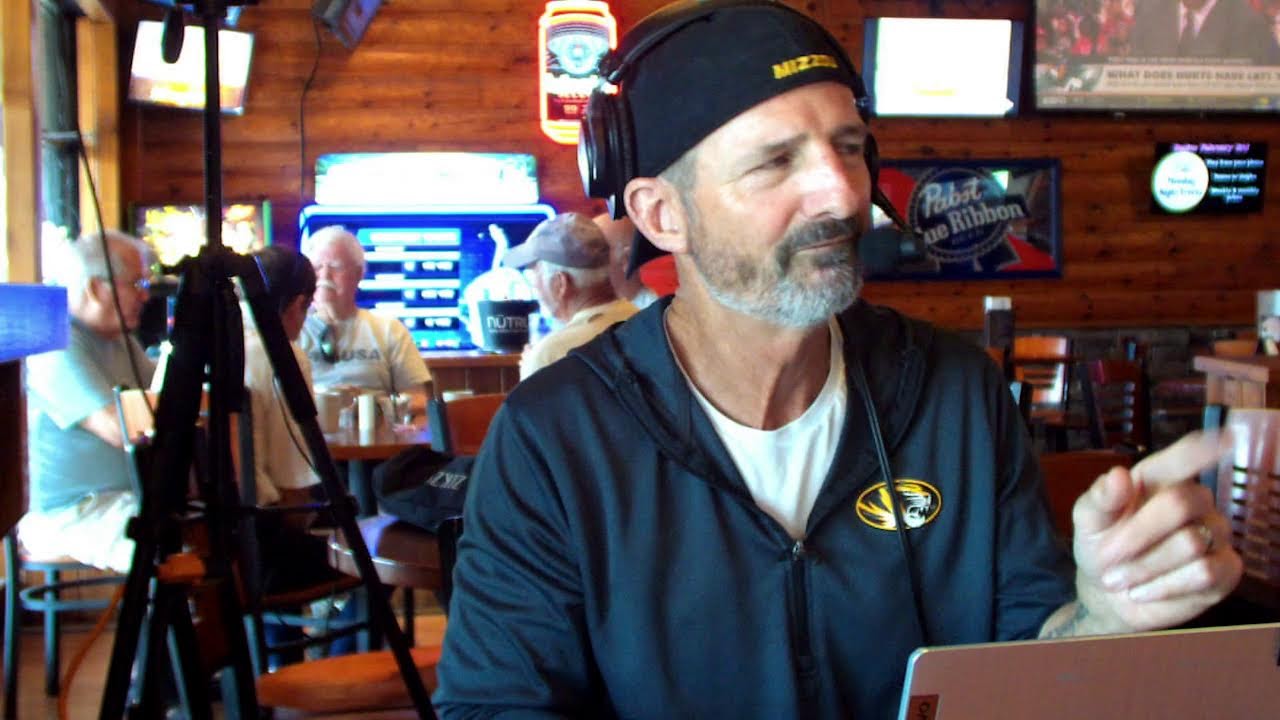
Whether we like it or not, he's the self-proclaimed governor of Mid-Missouri, and he's the host of TTBS, the podcast. Since we can't shut him the hell up, here's Tom Bradley. Thank you, Nikki Garman. Although sometimes I hear that tone, and I wonder, I wonder when she says the self-proclaimed governor of Mid-Missouri, and it's like, yes, I am. I mean, I proclaim that, you know, it's almost 20 years ago I proclaimed myself the governor of Mid-Missouri. That's awesome. 20 years. Holy cow. Right. So Nikki, don't have an attitude about it, because it's a real and legitimate thing. The guy you're hearing over here next to me is Ellis Benes, who's back around, and I love what you sent me yesterday. It was like, hey, am I on the show tomorrow? Do you still want me? You were off for one week, and Aaron Rose did a great job last week. He did. It was a great show last week. Both those guys were awesome. You caught the show, and you were like, he's so good, maybe Tom doesn't want me back. 100%. He was also a much better looking guy than me, much better dressed. I felt really inadequate. You came in trying to one-up him, because you brought in a hard hat. Yeah. Can you bring it? Yeah, you see me. For those who have video, you can actually see this now. I found this on the road. I actually thought that was like a toy hat. No, no. It is the legit Emory's hat. I found this on the road two years ago. I picked it up, and I...
Whether we like it or not, he's the self-proclaimed governor of Mid-Missouri, and he's the host of TTBS, the podcast. Since we can't shut him the hell up, here's Tom Bradley. Thank you, Nikki Garman. Although sometimes I hear that tone, and I wonder, I wonder when she says the self-proclaimed governor of Mid-Missouri, and it's like, yes, I am. I mean, I proclaim that, you know, it's almost 20 years ago I proclaimed myself the governor of Mid-Missouri. That's awesome. 20 years. Holy cow. Right. So Nikki, don't have an attitude about it, because it's a real and legitimate thing. The guy you're hearing over here next to me is Ellis Benes, who's back around, and I love what you sent me yesterday. It was like, hey, am I on the show tomorrow? Do you still want me? You were off for one week, and Aaron Rose did a great job last week. He did. It was a great show last week. Both those guys were awesome. You caught the show, and you were like, he's so good, maybe Tom doesn't want me back. 100%. He was also a much better looking guy than me, much better dressed. I felt really inadequate. You came in trying to one-up him, because you brought in a hard hat. Yeah. Can you bring it? Yeah, you see me. For those who have video, you can actually see this now. I found this on the road. I actually thought that was like a toy hat. No, no. It is the legit Emory's hat. I found this on the road two years ago. I picked it up, and I finally cleaned my van out, and I found it just stuck in the back of the minivan. You had no idea this was in your minivan. I completely forgot it was in there, man. That is awesome. So free advertising this morning. Honest to God, when you don't clean out your car forever, and it's the size of a minivan, you'll find things in there that'll keep a family like yours, the size of your family, alive in like a snowbank for a week and a half. That's the idea. I stock stuff like rotten milk, sippy cups. Nothing wrong with that. You're in Donner Pass. You're like, I wish I had that rotten milk now. It's cheese. It's cheese at this point. It's exactly what you're thinking. All right. We have some business to take care of before we get to our guest this morning. Our guest is Jason DiPrima, and I'm going to share this now, and not when he joins us on the show, because I want to get this out of the way right now. All right. All right. And I've known Jason for a while. He's been on the Tom Bradley show before, the radio version of the show, and I just wanted to share this with you. I'm going to share this now, and not when he joins us on the show, because I want to get this out of the way right now. All right. All right. And I've known Jason for a while. He's been on the Tom Bradley show before, the radio version of the show, and I just wanted to share this now, and not when he joins us on the show, because I want to get this out of the way right now. All right. All right. All right. I think he's been a long time listener, second time guest is kind of what you're gonna get the feel of today. He's a pharmaceutical professional. I've seen him at the Club at Old Hawthorne. I'm up at the Club at Old Hawthorne earlier this week, sex, and with a bunch of guys. They've just finished a round ago, like, hey, how did you hit today, Marvin? Well, I'll tell you what. And they're all talking about it. And I love the Club at Old Hawthorne. And good morning to Billy Sapp, who we got to have dinner with earlier this week also. But I'm up there, and sexy bass player goes, who's on the show this week? And I wanted to say Jason DePrima, but what came out of my mouth was, if I got, what came out of my mouth, I believe, was Brian DePalma. That's not even close. I don't even know if I have the right name right, but I think that he's a well-renowned movie director. Let's Google it. Is it Brian DePalma? This is what I'm here for. I think, I believe that it is. Brian DePalma. And that's what came out of my mouth. And I swear to God. American film director and screenwriter. Yeah. Yeah. And I swear, the bass player looked at me, and he said, when is his brother, Jason? He didn't even miss a beat, man. And I started fixing it. And I go, I don't know what I said. I'm talking about, I am talking about Jason. What did I say? And the guy next to me goes, I know a Jason DePrima. Don't you talk for a living? Not anymore. Not anymore. Not anymore. Not anymore. I do all kinds of other things. We're live at Truman's Bar and Grill, where it seems like every week I get to tell you about some sort of live music, which they didn't used to do this stuff, and now they're like party central. That's awesome. So, AKA is back. That's a live band, also known as, that's what the name is also known as, AKA. That's the band. Oh, AKA. I heard eight. AKA. AKA. Also known as. And they'll be in tomorrow night, Buck 50 draft and $7 pitcher specials. You know, there was a time we couldn't promote the price of alcohol, and you couldn't promote alcohol specials. Did you know that in the state of Missouri? Well, I remember there was a time of prohibition. Is that what you're talking about? I remember. I've got to take it off camera real fast there. Right now. That's it. You're off. No, no, no, no, no. I mean, we couldn't sell beer or anything above that on Sundays. You couldn't say, hey, two-for-one specials. I mean, none of that stuff. Was that like an FCC thing? Like, was that a radio station thing, or it was a Missouri state law? That was Missouri law. Interesting. Involving alcohol sales. And when did that stop? When I told them I was sick and tired of this crap. The governor has spoken. Yeah. And that's what it happened. Tomorrow night, the party starts at 7 o'clock. No cover. And as always at Truman's, no reservations. Excellent. Yes. Ellis Bennis is back from floatingaxe.com. He is our internet guru. Would you like a different title, or do you like that? I'm digging that. Yeah. I'm digging that. Okay. That's what I was thinking. I was thinking about Jason's title, though. Pharmaceutical professional. I feel like some of the folks we've been talking about lately are also pharmaceutical professionals, just on the consumption side. You may be right about that. We've got some things to talk about with Jason. Yeah. I'm excited. And his cousin, Billy. Anybody else? Maybe you can bring Billy on with him next time. That's absolutely right. Okay. We're time for our … It's going to be a dual announcement this morning, but we can't announce anything until we release the hounds. Release the hounds! By the way, Daisy Jane and this first heat cycle of hers, oh God, it's not ending any time soon. So we're going to be out in the wilderness this weekend for Labor Day weekend, and we're going to have Daisy Jane with us, and Deb's like, what about any other males that aren't fixed? What about them? And I go, that's their problem. And she goes, I don't want anybody tearing into our tent or anything. Announcements this morning, releasing the hounds brought to you by our great friends at Creekside Pet Center and Bed and Biscuit and Dirty Harry's in Boonville, and they're having their pet-tacular birthday bash coming up in September. It's on September 13th, a Saturday, 10 a.m. to 4 p.m. at Creekside. I want to tell you a couple things. Number one, yes, it is their 10th birthday, but do you know they started the pet-tacular when they first opened up? They had a party out there, and I was there for that first opening, and it was like, wait a second, dogs running free, kids having a blast, face painting and balloons, and a beer garden. I think Baroque was there. They're going to have three different food trucks there this time around anyway. That's a big deal. Follow them on Facebook, all of their locations. Here's the dual announcement first. Next week's guest on TTBS is going to be Sarah Hill, longtime member of our community and really a community leader in our area, for years on KOMU, and a longtime friend of mine as well, and a colleague in media as well. What a joy Sarah Hill is. When I saw a post from her earlier this spring or earlier this summer that this spring she had a heart attack, and she's extremely in top physical fitness, takes care of herself very well, and I'm like, how the hell? So apparently, I know women do not spend enough time taking care of themselves, they're focused too much, especially as they get older, on their husbands, and especially when we talk about something like having a heart attack, but women can't, and this is a specific type of a heart attack that women can have, and she's had this very difficult on her, and she spent a couple of months in rehab working on things, and did not post about it to the rest of the world for a couple of months, so she's going to join us next Thursday, first Thursday podcast in September, but one of the interesting things, when I bring up Sarah, that I want to mention this also, is that she is the person who introduced me and pretty much everybody else in Central Missouri to the Central Missouri Honor Flight. Yes, great organization. Way way back. My uncle was a Vietnam veteran. The only time in his 72 years of life I've ever seen him get really emotional was when he was sharing his experience when he got to go on his honor flight. I recorded him, I kind of secretly recorded him talking about it. He's gone now, and it was so powerful to hear him talk about that experience. It was amazing. I'm sorry you've lost him. I'm glad you had the time with him. He's the greatest dude ever. And look at your sweatshirt you're wearing today, man. We the peeps. It's a little tongue in cheek, but you know, Menards, baby. It's good. You're proud of your patriotism, and you're proud of this country, and you're working on it, which you are all of those things, and I thank you. The Central Missouri Honor Flight apparently were coming up in September on what appears to be their last honor flight. Oh, wow. They were accepting applications to join on honor flights, and those applications finished. They hit their deadline September 1st of 2024. So as I understand it, this is our last one. I believe I'm going to join the Patriot Guard and ride on the Escort in from Kingdom City if I can, but the date is September 15th. That's a Monday, and that is flight number 71, and I believe it's the last. So I wanted to bring that up and make sure that you're aware of that. That's awesome. And yeah, I want to thank Sarah Hill for bringing that to all of our attention so many years ago. There wasn't a Central Missouri Honor Flight. They were happening in other places, and it started happening here. Really the majority of the reason was because of the passion that she felt for that, and what she was doing. So Sarah will be our guest next week. I guess that brings us about, I think that takes care of enough of our business over here. That means we need to then go to our full camera shot, and welcome aboard our guest this week on TGBS The Podcast. I've known this guy one way or another for quite a while, but he's a gentleman enough to have, when he saw me up at the club, at the Club at Old Hawthorne a few months ago, last year sometime, he introduced himself to me by name, because he knows either I meet so many people, or I'm a horse's ass and can't remember anybody, Jason DiPrima. Both things can be true. Or as we like to call Brian DiPalma, good morning. Brian DiPalma. Perfect. Good morning and welcome to the podcast. I appreciate you being on with us. Thank you. Before we get into this, I promised somebody I'd do something, I've got to say hello to you from somebody. Okay. Dan Jacobs. DJ. The man. The mythical legend. It's my mom's husband. He said, he was telling me he worked with you and a bunch of guys back at the KCMQ KTGR back in the 80s, and he said it was the worst paying, but the most fun job he's ever had. Sometimes I wonder if people pay you crap if you wind up just finding a reason to have more fun, because we all made very, very little money. It's so little, I hesitate to say we made money at all. Dan Jacobs is one of the most creative minds I've ever spent time around, and we worked together for three and a half years, and he's the best copywriter, which means really, I guess on a day to day basis, the best writer I've ever been around. He's one of those tremendous talents. He would write radio commercial copy according to the talent, that's what we were known as, the voices, according to which talent was going to read it. Oh, wow. He'd be like, okay, Bradley, Bradley, my man, I've written this one for you. I'm like, really? And then he'd put on his radio voice. I can hear him saying that. And he'd go, okay, so, and I'd be like, wow. That's awesome. And your mother, I've had a chance to know, and that's wonderful. Thank you for that. I appreciate that. Absolutely. I listed you somewhere online, or in my mind, or whatever, as a pharmaceutical professional. That's fair to say, right? Sure. You were mentioned to me by several people over the last month, because we talk about homelessness and homelessness problems that we're going through in Columbia. And I will tell you the probably top five reasons as to why someone is on the streets. But coming in there with a bullet, all right, is going to be one of the following, substance abuse or mental illness. Interestingly, as a pharmaceutical professional, someone who has spent a career working with these things, you know a lot about drugs. And not just prescribed drugs, which can have their own issues going on, but also illegal drugs and addictions thereof. And of course, prescribed drugs wind up being on the streets illegal, and then people consuming them illegally as well. And mental illness quite often has, there is a solution out there for mental illness problems for individuals involving medications. But for whatever reason, they might not be on those, and that leads to disaster for their life. Where do I begin a conversation like this with you? How do I turn it to you right now and say, what are we dealing with on the streets? With what you know about drugs, what are we dealing with on the streets? Sure. I'll give you a brief background, just so everybody knows where I'm coming from. I think it's easy to say, pharmaceutical professional, I've been in pharmaceutical sales for 20 years. The last six years of that, I've worked for a biopharmaceutical company that specializes in neuroscience. So we have two different arms. One arm is kind of the psychiatry arm, there's a couple medications for schizophrenia, things like that. The other arm is the addiction arm, which is the arm that I'm in, which we have a medication that is used to treat alcohol and opioid use disorders. I have intentionally kept the name of my company, the name of my product, out of everything that I've done, because I don't want it to be, I don't want anybody to say, oh, he's just doing this for any kind of personal gain. Trying to keep that out there. But… But at some point, I might ask you the name of these drugs. Sure. And in particular, is that one drug you're talking about? Just one. Yeah. Opioid and alcoholism. Oh, opioid addiction and alcoholism. Correct. And it is one drug that works on both of those issues? Yeah. And we'll get into this today, but it pretty much all comes down, I mean, substance use disorder, addiction in general, whether you're talking about a substance, food, sex, gambling, exercise, all has to do a lot with the dopaminergic pathways in our brain. Once that trigger, you know how to pull it, you know how to go out and make that trigger happen. You'll go out and find a way to do it, won't you? Correct. So the brain, the brain wants to stay in what's called a homeostasis, right? So the brain, the brain balances pain and pleasure. Okay. So little dopamine rush, normal things like, you know, the waitress here sets down your food in front of you and it looks really good. You get a little spurt of dopamine. You know, you get a compliment, you get a little spurt of dopamine. Let me ask you, okay, what about if I see my youngest grandchild who's a year old and I get to hold him? A little bit of dopamine. These are all normal amounts of dopamine. Okay. So we start here with this balance. You get a little bit of dopamine. Well, the, the, the, the scale starts to tip. So the brain wants to bring us back to even. So it throws in a little bit of pain. When I say pain, I don't necessarily mean physical pain. It manifests in different things. Anxiety, depression, nausea, anger, just discomfort. Those are kind of the most extreme versions. That's kind of what we typically think of, of withdrawal symptoms. But it, it also manifests in, if you're watching a Netflix show, the show ends and you're trying to sit there to decide whether you watch another one or not, that's, that's kind of the, that's where the brain is. You know, you've been watching the show. Your dopamine has been up here. The brain's trying to get you back down here. And so normal, most of us over a period of time in this example, watching a show after about a minute, you'll be able to get through that and say, I can't, I'm not going to watch another show. I got something to do. You'll get back here. If you're somebody who has an addiction to something, substances, what we're talking about here, but anything that they're getting normal than more higher than normal dopamine spikes during this. So in order to balance that, the brain is doing more than normal pain to bring that back in. And so when somebody has a sustained history of using a substance, they can't just wait for that, that, you know, that curve to come back up to get to, to balance, right? So that's where, that's when they go out and they're seeking that substance or they go out and gamble again, or they go out and eat again, whatever it may be. Because it's not just a little curve that comes back up to normal. It gets way down here. And so the only way to make themselves feel better is to go way back up here again. So, so you, and you said that could be the case with any addictions out there. So when, when I, when I first started hearing about sex addiction, I was probably about 25, 30 years ago, something like, I don't think it was ever around that we said anything about. And then Michael Douglas came out and he's like, yeah, apparently I've got a sex addiction. And it's like, I'm thinking, no, no, dude, you just, you just like getting out there and doing things you shouldn't be doing. Now you're blaming it on that, right? But the way you just talked about it, Jason makes it sound like it's like any other, it's real and it's like any other addiction because it has to do with the dopamine. Yeah. So addiction is a brain, if anybody listening takes one thing out of this whole thing today, addiction is a brain disorder. It is not a behavioral disorder. I think the tendency for a lot of people to look at somebody and say, why don't they just stop doing this? Why don't they just stop doing these drugs? It's caused them to alienate their family. They're stealing from their grandmother. They're, you know, these types of things. Why don't they just stop doing that? Well, it's not a behavioral thing. It's a brain disorder. There are, you want me to, I can, I can, I can summarize addiction and substance disorder in about two minutes. If you want me to go through the whole thing. I'm really enjoying this and I don't, don't rush because I think, I think a lot of us believe we know something about it and we've known alcoholics and we've known drug addicts and some of them are in our immediate family and in our household. Okay. So we think we know something about it, but you've already opened my eyes to a lot here. So this is, you know, you said I'm a pharmaceutical professional. 20 years ago when I first started, I was in the kind of stereotypical pharmaceutical role where I was running around dressed in a suit and bringing lunches to offices and kind of a glorified caterer. Yeah. I'm just being honest. A well-paid caterer. I'm just being honest. Well, I wouldn't have done it for 20 years if it didn't pay very well. But no, for the last six years I've been in, I've been in this, this, this substance use disorder space. I don't have any personal or family ties to substance use disorder. I had a lot of the same stigmas and misperceptions of substance use disorder prior to taking this position. Over the last six years, that has significantly changed. That's what's changed kind of how I view our homeless problem as well. I drive around town and I see the same thing everybody else sees and I'm frustrated. You know, no, no city, no town, whether it's the citizens or the government wants to have people on all their corners who look like they desperately need some kind of help. Yeah. A lot of people drive around and say, oh, they're all just these drug or alcohol fueled, you know, vagrants. They did, you know, they, you know, they just want to do this or that. I drive around and I see people and I'm like, that guy needs serious freaking help. Yeah. And I'm not in this, let's just, I'm not in the camp. Let's just round them all up, throw them in jail, put them on a bus, send them out. We can't villainize, dehumanize, criminalize these folks where I, where I think we're missing the boat is what we're doing about it. Right. Okay. So back to the addiction thing. There are two parts of the brain that are associated with addiction. Pretty much any kind, but let's just keep it to substance use disorder. You have a smaller part of the brain called the limbic system. That part of the brain has different components, but that is the part of the brain that is, that's our essentially our reward center, our pleasure center. That's the part of the brain that says that felt good. Do it again. Yeah. Okay. Okay. Then you have the cortex. Cortex is typically responsible for decision making, thinking, reasoning, things like that. Okay. You can't really adequately treats an addiction of any kind without addressing both. Okay. I, I, I typically say the limbic system is like a, is like a, like a, like a screaming toddler. And the reason I say that it says, give me the next cookie. Give me the thing. I want the thing. It's also a distraction. So if I'm sitting across from you in a therapy session, you're my counselor and we're talking, how effective is that going to be if my toddler is rolling around on the floor screaming the whole time? How much of this will I absorb? Yeah. Nothing. Not a lot. If we're able to take that toddler out of the room, then this becomes a lot more, a lot more effective. And that's what the cortex is, is some level of reason and clarity. But in addiction, the limbic system takes over. That balance is, is gone. That's why the logic is gone. I mean, logically, I know if I do this again, I could die. I'm going to lose my family. I don't care. And you're, you're, you're not saying that this is necessarily when someone is under the influence. It's when they have an addiction because it's screaming. It's the toddler screaming right now. So they could be off of whatever it is. A hundred percent. Let's say it's two days out of, out of being on alcohol. Yeah. All right. So we know that their body's clean from alcohol. So this limbic system or, or, or center or whatever piece of the brain is screaming out. So the cortex can't operate correctly. I mean, essentially the term we use a lot is the brain has been hijacked. Yeah. Okay. So, so your brain gets to the point that it thinks that you need that substance as bad as you need air to breathe. That's why people will do anything they can. They know what they're doing is wrong, but it's the devil and the angel on the shoulder is what I call it. Limbic systems, the devil, the angel is the, is the cortex. The devil's going do it, do it, do it. That felt good. Do it again. Do it again. You need to do this right now. So when you think about that, it was somebody who's in an active addiction, especially substance use disorder. The cortex kind of just gets shoved to the side. So that's where something comes in called medication assisted treatment. Yeah. There's medication that is used to assist the treatment. The treatment being the counseling. Psychosocial therapy is still the crux of any kind of recovery. Most addiction is rooted in some kind of trauma. Trauma gets thrown. That word gets thrown around a lot now. Right. Maybe a little bit too loosely. Everything's trauma. Oh, we all have trauma. This or that. Kind of. But when we're talking about substance use disorder and serious addictions, those are really, really real traumas. What do you mean? Like something happened when they weren't using or it happened when they were using? A lot of times it happened prior that something that leads them to a substance use disorder. And it could be something that happened in their life. It could be a mental health disease. Co-occurring diagnosis between mental health and substance use disorders, there's a lot of it. Let me ask you about these drugs that we're talking about. When did they start becoming available? 1960s? 1980s? Years. Yeah. I mean, decades. Absolutely. But. I'm sure back in 1910 we were trying shock therapy. Right. Turn the generator and hook it up to this guy and he'll learn his lesson. Medication assisted treatment, adding the medication part is something that's, I don't want to say brand new. I mean, so the drug that we have has been out since 2006. A lot of them previous to that. But traditionally, treatment for addictions and substance use disorders was maybe some therapy, maybe it was group settings, your AAs, NAs, things like that, faith based programs. But again, and this is what I see when I drive around and see people and people say, all we need to do is get them this service, that service, these services. Well, that person's brain is not in a state for you to even have that conversation. You have to get people stable, whether it's substance use disorder or a mental illness. You have to get them in a stable spot where you can even have those conversations. I've joked, not that it's that damn funny, that why don't we go out with some level of a little blow dart and we're going to hit somebody with whatever drug is going to, and then for a moment, clarity will come through and they can hear you say, hey, I've got a thing for you. Because at some point they do have to, they have to have a moment of clarity, right? Is it just when things get so bad or what? So I mean, that's everybody, everybody's bottom looks different. You know, for some people it could be something as simple as maybe they got their first DUI. For some people it gets all the way down to they lost, their kids were taken away. They lost. I mean, the bottom is different for everybody. Substance use disorder is very individualized. It's not everybody who has it is very different. The treatment has to be individualized. There's not that many options. There's only three or four medications to treat opioid or alcohol use disorder. So, but traditionally, you know, that's only happening in specialized settings. Primary care doesn't really dip their toe into a lot of those, not very generally. They could, but it's just kind of generally viewed as not their purview. So it gets worse and worse and worse and then to the point that somebody either goes to a specialist to get it taken care of or they go down a pretty bad path. Let me, and I know we're going to be, I'm going to be jumping around from one thought to another. There's just so much to learn and I've got so many thoughts on it all and I know Ellis, you might as well, but I want to say, look, I remember some great times in high school. I'm never going back there. You know, when I left, I was like, that's the end of that, but I remember some good times. If someone's on drugs or alcohol and addicted to it, if they get themselves clean for a week or a month or a year or whatever it is, they still remember good times. So I'm not talking about the dopamine and the screaming toddler and maybe they're on medication to help them, but they remember a good time in their life. You know, I remember my friends, we'd hang out at the lake and I would drink two cases of beer every weekend or we'd start doing the Captain Morgan shots and they remember those good times. That was a part of their addiction. They were drinking a lot of alcohol during that time, but they remember those good times. Will they ever think about going back? Not because they're right now physically needing it, but because they remember the good times and they want to go back to their high school? Absolutely. They will. Once someone is in recovery, you're never not in recovery. Once you are in recovery, you're in recovery for the rest of your life. Addiction is a disease. It is classified as a disease by most major medical associations. It's chronic. It is a relapsing and remitting condition. It affects the organs. I mean, everything that you kind of check the list of what is considered a disease is it is a disease. And someone who is an addict, addict is always an addict. Yeah. I love that you said that about the brain balance thing is like, I mean, somebody that's schizophrenic is never not going to be schizophrenic. They can take their meds. It's whether it's managed or not. Exactly. Whether it's managed or not. And you had said a minute ago, let's focus just on, you know, the substance abuse. Well, no, let's zoom out from there. Because like my wife and I are obsessed with watching the TV shows about like Biggest Loser, My 600 Pound Life. And you look at these people and you're like, you can't walk. How are you still eating what you're eating? And it's addiction. It is a brain disorder. And so the Biggest Loser, 80 to 90% of those people, we just watched a documentary on it, have gone back to their starting show weight and are probably heavier than that now. And these people got down to the best fitness they've ever been in their entire life. They're off all these medications. They celebrated. But that addiction component was not solved. And so they're still seeking that high. Is that the same thing then, like you're saying? It's an addiction. It's very similar. So, I mean, that would be, you know, they got somebody in a program, essentially is what you would call the show, that had them on the right track. It was structured. Everything's totally controlled. You have no choices, basically. Right. I don't remember. I don't know that I've watched it a couple of times in years, but I don't know during that show, you know, do they ever do counseling sessions after that? They added that seasons later. Why did you start? Yeah. They added that seasons later. Right. So if you have this kind of structure and these things keeping you in place, and it's the same type of thing with any addiction, so you're always in recovery. And that's the thing you have to understand about substance use disorder. It is a relapsing and remitting disease state. Most people with a substance use disorder, even when they get clean, at some point may have a relapse. It may be small. It may just be a slip that, you know, they're out with some friends and something happens, but then they're back on track. It could be a full-blown relapse where they go all the way back to, you know, the really downtrodden places they were. Well, then looking at other addictions, whatever it might be, like a gambling addiction, do gambling addicts, do they have relapses also about the same amount, same sort of a timeframe and everything else that they do? Yeah. And you said earlier, not to bring back in the dopamine, but it is the dopamine. And here's the reason why. Triggers that can cause somebody to relapse or have a slip, thinking about that good time that they had with their friends back in high school, that can be a trigger. That goes back to, gives them a little bit of dopamine, right? Then their brain has to balance it out again. But they're thinking about it, and that thinking feels good to remember it. Ask anybody who's been in recovery six months, a year, ten years, if they still have thoughts. Absolutely, they'll still have thoughts. What about, let me throw this out there as I try to understand what these individuals must be going through. I was addicted to cigarettes. Is that the same thing or not the same thing? Pretty much, yeah. It is. I mean, it was really difficult to get over. But the longer I went without cigarettes, the better it got, the easier it got. I have zero. I will never, ever go back to cigarettes. You can call me a smoker for the rest of my days if you'd like to, if it makes you feel good. I'm not. I will never smoke again. Because you don't have a physiological dependence anymore. So addiction and physiological dependence are very, are kind of, you can kind of intertwine those. So I wasn't necessarily addicted. I had a physiological need. You got addicted to it because, like I would say, and maybe this is too strong of a statement for this. Yeah, because your neurochemistry, that dope. It works, yeah. You got out of balance. Like he could stop smoking and stuff because you got out of balance and then you're rebalanced. So I'm going to be honest, I'll just say like I have an addictive personality. I saw my family go through this and so I have all, you talk to me about I've never drank alcohol in my life because I know my family history on both sides that I am deeply terrified. If I ever took one drop of alcohol, I would be homeless in a gutter because I couldn't I gave up soda in 2011 and I think this is the same way addicts feel. I quit drinking soda in 2011. The desire for that has never gone away. Really? Oh my gosh. Yeah. Like I will smell a Mountain Dew across the room. And this seems ridiculous. You're a Mountain Dew hound. Oh dude. I was drinking two, two liters of Mountain Dew a day when I, when I was in, when college and high school. Now folks, if you're not keeping up on the metric system and it is United States, that's approximately a gallon. Yeah, there you go. A gallon of Mountain Dew. And so I say, I really do believe that I have that addictive personality. And so that's where a big part of my faith comes in. I'm so grateful for my family because I have just stayed away from that. But I, I, I had those precursors. I knew those things. I saw both sides of my family with massive alcohol addiction issues. And so I got those kind of like scare me straight or like, you know, knowledge things ahead of time. And I'm like, okay, I know this about myself. I'm never even going to touch this. Oh, look, that was probably a very, very smart thing for you to do in a lot of people. Genetic and environmental factors are absolutely part of it. So there are some genetic predispositions. When I say environmental, if you grew up in a house, um, I mean, I'll give you an example from one of the, one of the, one of the accounts that I work with that they had a, they had a client who in talking to her through her addiction, she went over to a friend's house when she was a teenager to have dinner with their family and they all had water to drink and she thought it was weird. Because at her house, everybody has a beer, right? But those are, that's the type of environmental factors. And so if, if your mom and your dad grew up drinking nothing to beer all the time, well, you're probably gonna start drinking beer about 12, 13 years old. And so there are absolutely genetic and environmental factors and not everybody has the ability to see it up front and be like, man, I gotta, I gotta watch out for this. Yeah. Yeah. I mean, and, and I would say that while there are genetic factors, you've got the environment right there. You can teach somebody to be an addict even if they don't have a genetic, you know, predisposition. What did you call it? The chemical dependency? Physiological dependence. Yeah. The physiological or the chemical. Like, like cigarettes. If you weren't an addict, you can still get addicted to cigarettes or you can still get addicted to alcohol because you get, your body gets used to it and so you can like turn yourself into an addict. But I do, I truly believe that there are the people, it's just a mental disorder. No different than schizophrenia, depression or anything else. Yeah. I talked to a DJ earlier, Dan Jacobs, what a great guy he is. We used to talk back in the day, it's like a hundred thousand white rats can't be wrong. I mean, they go to the cocaine dispenser in their little habitat, whatever those things are in a lab until they kill themselves. They will forego everything for the cocaine they become addicted to. And me, I looked at it and I'm like, that's exactly right. That's why I've never done cocaine. That's I mean, I don't want to, I don't want to go there. So many people are using marijuana today. I'm a little worried about, about some of them, not all of them because I've never thought of something as a gateway drug. Do you believe in gateway drugs? To an extent, but here's something interesting I heard about marijuana. It's especially dangerous for youth. You know, us retirees, people who are older, you know, I mean, that's all fine. Younger folks, their brain is still developing, so that cortex part of the brain doesn't even really develop until somebody's probably in their like twenties, mid twenties. Right. Right. So that's why it doesn't fully develop, fully develop. Correct. So teenagers, adolescents are much more prone to impulsivity and things like that. Their amygdala takes over. That's the part of the brain that's kind of telling them to do things because the other part is not fully, fully developed yet. And so, you know, I mean, it's, that's what I'm saying. If you, when you look at addiction as a brain disorder and, and understand the neurochemistry and the things that are happening, that helps. And this is where I think we need to go to, to get into the broader topic. This is what I'm going to be advocating for with the city. Okay. We do a lot right now when talking about homeless population and talking about housing. Yeah. We need housing. We need affordable housing. We need to get people into housing. Right. And that is absolutely part of it. If we put as, and I'm not asking within the city, take effort or time or resources away from that, but bring mental health and substance use disorder up to that same level. Because here's the thing. You can put somebody in a home, but if you haven't addressed the mental health and substance use disorder, things are probably going to go bad. You can address somebody's substance use disorder, but if they don't have a home to be in, that's probably going to go bad as well. You have to, you, both of them are equally important. You really can't have one without the other and be really like successful on a, on a bigger scale. When I, when I looked at people immediately talking about affordable housing being the issue and why we have people out in the streets, it's like, okay, someone's sleeping on hot concrete on a 92 degree day at noon. That's not because his apartment was too expensive. Right. Right. I mean, that has nothing. This person is not able to make good decisions at all anymore. And that's what we're seeing. And it's like, we can talk about affordable housing guys, but that's not why he's sleeping out there. Right. You know why, why someone is in a port-a-potty down at Flat Branch Park in downtown Columbia. Why someone's in a port-a-potty sexually servicing someone else to get money to buy a drug has nothing to do with affordable housing. And so we get, we get caught in this kind of prison of two ideas or it's very polarizing where if you speak out somehow against homelessness and you don't like it, you want to see things changed. Well, there's a crowd over here that'll say you're, you're dehumanizing or this, you hate the homeless, all this kind of stuff. You're like, no, no, no. I'm, I'm saying this is an issue and we need to fix it. And then you have people over here just don't want to talk about it. And I'll say this and I'll say it till I'm blue in the face, not being willing to talk about mental health and substance use disorder or dismissing it, downplaying it is equally as stigmatizing and harmful to those people as the people who say really mean uneducated things about people who have addictions. You know, earlier you mentioned that it's not fun to see this on our street corners. And I was thinking about, we mentioned this before the podcast began. Someone did a little graffiti on a, what is it, an electric box or a cable box? And they put fuck Trump on there. And I, I don't enjoy graffiti to begin with. Even the people that are really talented, it's still like, oh, come on you guys. I like the look of nice bricks, you know, a nicely sited house or building. That's what I really like. That's a great story, grandpa. I'm not, I'm not really into graffiti. So if you've gone over there and you've been like, uh, battle high school sucks, I'm still not enjoying it or whatever. This is not about Trump. It's why did somebody have to spray paint this out there? And I don't like the look in Columbia. And I know I'm like a grandpa on this thing I look at. And I don't like seeing homeless people who are addicted, who are users, their mind is completely blown to hell on our street corners here. I don't enjoy that. Does that make me bad? Just, I want to ask you, Jason, does it make me bad? Like I said, I don't think so. I think, I think it's a generally accepted concept. Even if you talk to city leaders, if you ask them, would you like to have more or less panhandling in your city? Is anybody ever going to say, oh God, I hope we can have more. Well, from my point of view, they haven't said enough that they, that we have too much and that's something. If somebody you would like to advocate with and for the situation with the city, how do you, how do you picture yourself working with the city to get them to? So here's something interesting that I found out over the last month or so, you know, the city has all kinds of commissions. We have a housing commissions. We have all these different commissions. The city has a substance abuse prevention advisory commission. Do we really? They just met on August 12th. It's made up of a group of, I think there's eight or 10 folks and, and they're really experienced educated. I mean, there are people with lived experience with substance use disorders. What do they do? So the meeting on August 12th was the first one they'd had in a year in their legislation. It says they are to meet at least quarterly. They had three meetings in a row that were, that they, that were canceled because they didn't have a quorum of, of people, of people on the commission. That could be for various and sundry reasons. I'm not trying to point the fingers at them and say, people just aren't showing up, whatever. There could be reasons. I also know that that commission most recently were asked, what do you guys do in relation to substance abuse in our homeless population? And the answer was, we've never, we've never discussed it or never. It's never really been a thing. We don't even know if it's in our legislation. I've looked through their legislation. There's nothing that says that they can't, right? But here's the problem. Another thing I'm learning, city council members, even the city manager, they cannot direct city employees to do something. They can ask questions, but a city council member can't go to one of these commissions and say, I want you to do this. They can be, they can be removed by the state attorney general. They're not allowed to direct city employees, even to, even to Carlin Seawood is not allowed to direct people. These are two different things, right? Though we're talking about there's city employees and then there are people who have volunteered to join in an advisory panel. But I think if they're on that commission, they're, they're kind of counted in that, in that group. So a city council, a city council member can't go to that meeting of the substance abuse prevention advisory commission and say, I want you guys to start tackling the, she, she, he, they. They could, they could propose. They can ask questions. But they could propose at a city council meeting an idea and they could rule on that as a, as a committee, right? Could a city council say from now on, we'd like the drug abuse advisory commission to do this, this, and this. And they could, they could change what that commission's. I think so. Or they may have to ask, they may have to do it in the form of a question. Can we this, this, this, or that? But, but, but because the city council members pretty much, if they want to do something, they'll go through the legal directions to get what they want done. And by the way, no, none of them are talking about homelessness like we are right now. No, none. I mean, if they're doing it, they're closing their doors and hiding so they can discuss what we're talking about in an open forum. I just shared the link to that commission. There's 10 members on that commission. So if anybody knows any of these folks, click on that link, reach out to them, ask them if they'll come talk to us. I don't know why they're not meeting because they're all stoned. That's why. I highly doubt that when you look at people. But they have people from the university that they have one member has to be under the age of 25. They have to have, several of them have to have lived experience. I mean, it's a, it's a good group of people. I don't think they're being used the way that they could. But this, this all comes back to my whole reason for even being here and being vocal about this is that we have to stop being afraid to talk about mental illness and substance use disorder. And I think, I think the hesitation of people to do that is because, well, if you start talking about people having drug and addiction problems, then this crowd over here is all just going to start screaming that they're all just drug addicts. And that's, it's viable. There are people who will, who will, who don't understand who will, who will scream out things, but you just, you have to talk about it. If there's anything you wanted to make sure that you got across this morning while we're doing this, while we're live and you please do so, because this time's going to fly by and we're going to run out. When you first started talking, I'll bet there are some people that caught the beginning of this thing and they probably thought to themselves, well, this, uh, Brian De Palma, this Jason De Prima, Jason De Prima sounds like a blank. He sounds like he believes in this and this and this. Some might've said, well, look, he's like defending people that are out there on the streets and he must be a bleeding heart. Would you ever consider yourself to be some level of a bleeding heart? I mean, I'm, I'm pretty much the exact opposite. I've, I've made, I've made jokes with my friend. I mean, I, I consider myself a pragmatist. So what that means is my brain gravitates towards the realistic as opposed to the idealistic. I don't think there's wrong, there's nothing wrong with either thing. My brain just goes here. If somebody sees something and go, man, I really wish it was this way. I see something and I go, unfortunately it's this way and this is how we have to approach it. So if I see somebody on the streets and I know that they're wasted on drugs and my reaction is like, look, there's another loser out there doing this stuff and, and why, and really getting into them making a choice and becoming this, you, you're not going down that path. You say, here's another person that has a massive substance and addiction problem going on. Generally the pragmatist to me also says I a hundred percent know that there is a subset that are for lack of a better term, just kind of shit bags. They enjoy not having rules, not having restrictions, being able to use a substance without any kind of consequences. It's a small portion. Yeah. Okay. The actual prevalence. I, I, I did some research on this cause I was curious because I had somebody recently try to tell me that it's, you know, Oh, you, you're just, you're just trying to conflate addiction with homelessness. I get that all the time. You're just trying to conflate this or that and say that they're all home. I'm never said that in 2024 there was a big meta analysis. They looked at almost 50,000 homeless individuals across nine, what they call high income countries. I don't know. High income just means like developed, you know, they're not going into the first world. Yeah. Correct. Um, 50,000 people, a meta analysis, so they go back and look, 67% had a current mental health disorder. Right. Now that's mental health and substance use disorder combined. What was that percentage again? 67%. Okay. Um, the most common conditions in there were 44% substance use disorder. And then you have antipersonality, major depression, bipolar, schizophrenia, right? But that's 67%. I had someone try to tell me it's only like 20%. It's only 20, 20, 25%. I'm like, okay, even if it is, you don't get to this level without that usually, even if it is, that's one in four, one in five. Yeah. That's the one to help them. Here's the question I always bring up. If one in four or one in five of our people that you see on the street had cancer, would we just be dismissing it and not wanting to talk about their cancer? If it was diabetes, we'll be, no, we'd be like, we've got to help these people. They need insulin. They need care. They need, they have a chronic, they have a chronic debilitating relapsing and remitting disease. I really like practical application. What can I do today kind of thing. Let's say one of these people has the substance abuse issue. Let's say they have a mental health disorder. Your company or whatever, they have this pharmaceutical intervention aspect of it. How could, I mean, not that we can force anybody to do anything, but how would somebody even get to that point? Let's say we have a loved one that we feel like could benefit from this. Is this like, do they have to go to a special place? Do they have to go to a special clinic? Do they have to talk to a special doctor? What is the pathway to have medical intervention towards, you know, getting over this stuff? There are different pathways. And that's kind of admittedly part of the issue right now is that programs like that are often full and they only have a certain amount of funding. And so they can't take a new person in until somebody gets out, whether it's because they're better and they've graduated and moved on or whether it's because they relapsed and dropped out. So a lot, I mean, it's a lot of funding based. So that's the thing. People are like, well, there just aren't services. There are plenty of places in Columbia that provide services. It's just, do they have the bandwidth and the funding to take in more? So Compass Health, there are a bunch of those locations all over town. They do really good work with substance use disorders. Burrell does really good use of substance use disorders. There's a mental health agency in town that I work with pretty frequently that to my knowledge has never been approached by the city in any way, shape or form. They are the only agency in Boone County and one of only 10 in the entire state who received federal funding through SAMHSA for a program called PATH. And I can't remember the exact verbiage, but it's something to transition out of homelessness. They're a mental health agency. They go out into camps. They talk to people. They know these people. They have built the trust with these people. And trust is a big thing. You said they haven't talked to the city, but they're here and they're reaching out to the homeless and they're working in our community? They are. And these are the people that I trust when I go ask them. I was with them recently and I was like, all right, I have to ask you a bunch of questions. And I may be, I may have some assumptions. Correct me if I'm wrong. These types of things. I asked them different questions. The first one I said was, I quoted that number. I said, I've seen that, you know, it's anywhere from, you know, 21, 25, even up to like 44% of homeless individuals have a substance use disorder. When I said that in front of these people, the first thing they did was go like this. Higher. Higher, higher, higher. I also asked them about, and this is kind of interesting, you'll see, um, ABC 17, Megan Drakus has been doing some, some stuff about homelessness in Columbia. She's done some stories. She did one on the Opportunity Campus and she quoted a number that's given by the Boone County Coalition to End Homelessness. She quoted it again the other day on Facebook. Okay. In the story, it said the number was 450 something in September of last year, and now it's down to 280 something. And I heard that and I was like, there is no effing way that our homeless population has decreased by almost 50% in that short time. There's new faces every day. So I did some digging. That number is what's called a prioritization list. Those are people who are considered chronically homeless. That's a whole nother thing is there's, there's, there's different definitions of homelessness. Right. Chronically, you have to be chronically homeless to get on this prioritization list. Those are people who are actively seeking housing. Okay. Then there's the point in time count. They do like once a year where they- Right, right. They hold events to get people to come out so they can actually get a count. The folks that I know that work with, they go out and have this program and work closely with the homeless. I asked them, I said, what is that number? And they said, well, not even close. I said, what is, what is it then? Like, what would you say? And they said, I would say an actual count of our homeless in Columbia is probably closer to a thousand. Wow. I thought you were going to say over 500. I had no idea you were going to go to a thousand. At this point. Is there any reason not to mention this program by name? Like that we could get involved with it, that we could ask if we could help them. You want to not? I don't, I don't have their permission to pull them into what I do, so I'm just trying to keep it. But. The damnedest thing is, and I don't want to bring this up, Jason, is that I feel like the point in time homeless person count that happens every year across the United States, I think there's a, I think there's a reason to do that. I think it's wonderful. Agreed. And it makes sense. But I believe some of the people at the beginning of it wanted to use those numbers for their own already decided on agenda. Okay. That could be someone who's against those individuals and against considering them as people and considering their rights. Or it could be someone that wants to over-deliver our resources, all of our resources, and devote it to them. I'm saying there was an agenda. And all of a sudden now, those numbers aren't being shared right now and people are going to a different number. They want to deflate it. And I don't know why we're looking to deflate it. We know the number of homeless in Boone County has been growing for the last five to ten years. It keeps on growing. If you have eyes and a functioning brain, you absolutely know that. Right. It's not like they all decided. They had a meeting. All the homeless people got together. They go, hey man, we've been talking about this. We're hiding too much in the shadows. We need to get out in the front. From now on, I want to see this on doorsteps. I want to see us out there on the highways. There's more people that are homeless in our area. Opportunity Campus on the Business Loop will be opening in about a year or so. Something like that. I think it's going to bring more homeless to our area. Will it bring more drugs to our area? More crime? More extortion? More human trafficking? Yes, because it follows homeless individuals and addictions and substance abuse. Here's my question about the homeless campus. I'll call it the homeless campus. When you go to stay there overnight, you can't go in there with drugs, right? Isn't that part of the deal? You can't go in there with drugs? I think you can't bring them in. I think it is kind of a low barrier shelter, which means you can be probably somewhat intoxicated when you're there. They're probably not going to allow you. Maybe they're going to have a safe consumption site. I don't know. If you're belligerent, then they're not going to let you. That's why it's not no barrier, it's low barrier. But they're not going to typically allow you to bring those things in. So if you were smoking or shooting up or snorting something, and it was in your baggage or your bag or your cart or whatever the hell, if you snuck it in and used it inside there, you'd be effed up while you're in there. And then the question becomes, will they do anything? I don't know. But I've been told there are homeless that will not go to a shelter overnight because of restrictions involving things like drugs and alcohol. There are things like drugs and alcohol. There's another aspect to it, too. There is an aspect of just how some of these shelters are run. Some of them separate men and women. So a husband and wife wouldn't want to go in together kind of thing. True. Now, I understand the way they may need to separate men and women sometimes, but there are couples that go in and don't want to be separated. There's also people who have pets. Some of these shelters, the pets are then put in a kennel in a back room over there. The subject of pets and the homelessness is a whole other very polarized conversation. But at the end of the day, that's why sometimes people don't go to these shelters. It's like, no, I'm going to be separated from my dog. I'm going to take my dog and put him in a kennel back there and I don't want that. There's all kinds of reasons people may not go to a shelter. This brings back a good point. The homeless are not a monolithic group. They are exactly the same as people who are not homeless. There are good. There are bad. There are people who have issues. There are people who will gladly accept a handout. It's a wide swath. Some people that are homeless are enjoying their lifestyle at that moment. Most of them probably are not necessarily enjoying it. But there are both kinds that exist. Absolutely. That's why you get people saying, no, nobody wants this. I don't know. Not many, but there's certainly a segment. There's aspects of it that I like. The idea of no responsibilities, no bills, no taxes. I want to live in the woods, unseen, unheard. I don't like people. There's not many guys I've talked to that don't like that idea. I just want to go live in the woods alone. I know a lot of guys that feel that way. I generally have my eyes on a patch of woods at any given time where I think I could survive in there. You said, Jason, you said you're a pragmatist. Are you also a realist? And so when you look at homelessness, you know it'll always exist. No matter how many homes sitting out here vacant we say are free, there'll always be people that are homeless. One of the saddest things I've ever heard, discussions with veterans who say when they got back from, typically it's from fighting overseas, when they get back they just don't feel comfortable being back in their home with their spouse and with their children and they wind up walking out and choosing to be homeless. It is trauma. The real trauma that we're talking about, PTSD, warfare, I mean after some of the stuff they've seen, it's crazy. Our law enforcement too, they see the worst of the worst of the worst. And then we're just like, oh, we just rub some dirt on it and get over it. Some people are like, check it out, that was the job, you chose that. I didn't choose for it to be like this. The same way people say this all the time, oh, well, you chose to be addicted to this or that. No one in history has probably ever picked up a drug or a drink the first time and said, man, I'm so hoping that I get hooked on this and it ruins my life. That's what I want. I give up every other thing that I do, watching the Chiefs go to the Super Bowl, caring about my daughter over here, the Camaro that I used to love. All those things are gone because of the drink or the coke or whatever. Nobody chose to have an addiction or get a physiological dependence to something. But that's just where it goes sometimes. I feel like it's two paths too. We've talked about these a little bit. There's either the social aspect, like you were just at a party and somebody was like, hey, try this one time. And then if you've got that addictive personality, you're hooked. That's it. That's what's going to happen. Or there's the other one of, we talk about the trauma responses, where you're like, oh my gosh, I cannot stand where I'm at. I cannot stand what's going on in my head. I need something to numb this. They are looking for a coping mechanism. I feel like those are kind of the two paths. And then in both of those paths, there are the people that can get back to homeostasis and they don't wind up addicts. And there's the people that are the addicts that once it latches into that brain, that screaming toddler is not going to shut up without my help. What do you think the success rate could be? Let's say that every one of them that's homeless out there that has a substance issue going on, an addiction. Let's say we were able to get them the drug, this drug to keep them off of that. What's our success rate? Are you talking like long-term recovery, like they get there and they stay there? Yeah. I'm not looking for three months. What statistics do you have around it? I'm looking for 10 years. That's an interesting, that's a good question. It's one of those things that it kind of varies. It varies by location. It varies by point in time. I mean, on the support network, I wouldn't, I think being realistic. I think if you're at 50%, I think that's a, you could be pretty happy about that. That's still a pretty amazing number. I mean, if there's a thousand homeless, if half of them have an addiction issue, we save half. That's 250 people. It is. But when we talk about this, and you're also talking about 250 people, but there's more coming into that funnel also. When we talk about this, when we talk about our time, resources, our actual tax dollars, whether it's federal, state, or the things we're doing here locally, and diverting money that could be going somewhere else where also people need it. The community is supporting some kind of cause out there that needs money, that needs some kind of attention from our government bodies, right? So if we, if we divert it over there, is that worth it or not? When you're running a business, if you go, hey, we could, we could start selling this on the side. Return on investment. Yeah. Yeah. Well, what are we going to get on this thing? What's the ROI? So your ROI on this thing, what's it going to be? And I think a lot of us, it's realistic for us to ask, what are we going to be able to get? We're running out of time, Jason. I want to ask you about mental illness and drugs for that. Here's my thought. Here's what I've believed all along. When you get somebody that has mental illnesses like schizophrenia or a bipolar or anything like that, when you get them on a good medication that's working for them and it works, you get them to the point that someday they'll look and say, I'm doing really, really well. I don't think I need the drug anymore. And that's when they stop taking it. I could be wrong, but that it doesn't require a new trauma. It doesn't actually just has a nice day and they go, I don't think I need this anymore. And they walk away from it. And that happens all the time, specifically in schizophrenia, because the hard part about treating schizophrenia, it's even harder than substance use disorder because somebody who has a substance use disorder, they know they have a substance use disorder, whether they're, you know, someone who has schizophrenia, it's about 50% of people who have schizophrenia who don't, who don't believe they have any issue. They look around at all. It doesn't say, no, you guys are all crazy. And so it's really hard to treat someone who either doesn't think they have a problem or doesn't want the help. And to your point, especially in schizophrenia, something like that, that happens all the time. Somebody gets to a really good spot and they're like, I'm good. We see you. And they're not. They were never told you'll get to a point where you're good and you can stop taking this drug. So they were probably told the opposite. And that's the thing when you look at substance use disorder specifically in relapses, a lot of people look at that and say, Oh, this guy relapsed. He fell back off the wagon. He, whoever he that they, he's a failure that failed. It's a relapsing disease state. So when people are in treatment, they have to be prepared to know you're probably going to have a slip or relapse at some point. If that happens, here's the plan, right? When that happens, call this person, call that person, call me, call your doctor, call your provider, call your peer specialist. Don't keep going down that path. So it's one thing we have to do is if somebody, you know, if you have a family member, a loved one, a friend, somebody who relapses from a, some kind of an addiction, they're not a failure, failure in his events. It's not a person. That's awesome. Say that again. Failure is an event. It's not a person. That's a great line. So when you see somebody who's struggling and you're like, man, they were doing so well, that person's not a failure. It's just something happened. Yeah. It doesn't mean they can't course correct. That's great. You know, you share a lot that really has a level of empathy and understanding and you've educated yourself for these things. And I have to say, I appreciate it. It doesn't change the fact that I don't want as many homeless people as we have right now in Boone County. And we've got more than our fair share in the center of Missouri, in the state of Missouri. And really compared across the nation, we have more than our fair share right now and we're making it worse. So I, I believe I'm right to want to change on that, but I thank you for opening my mind. I want it to change too. The last thing I'll say is I think we do a lot in Columbia to help the homeless. Those who are, I don't think we do enough to deter homelessness, right? I don't think, you know, we, we, we need signs that say, please don't give to panhandlers and donate to these causes instead. We need an ordinance that allows that you can't occupy and loiter, loiter on a median. Now, when you do that, people are going to say, well, this is the only people's source of income. We need a work program where people, homeless can go to one place, one time a day, get transportation to go do various and sundry jobs. They get a lunch, they get, they get an hourly wage. They get dropped back off. They can go do what they want. It gives them a sense of purpose. It makes up for that income. They may have lost from the panhandling. You need that. The ride home program we've talked about, if you're not from here and you got stuck here, we need to get you back home. I mean, there's a four or five pronged approach, pretty simple things that you can do with empathy that I think you should, we should, I think we need to be doing it before the opportunity campus opens. Jason DiPrima, if you want to come back on the show sometime in the future, and especially if we see some changes in one direction or another, please reach out to me. You got it. And in the meantime, also stay in touch and I'll keep an eye on it. Anything that's going on between you and any kind of a group you're working with and the city to have an understanding, if there's more that we can do from, from our perspective, from where we are to help the city, help you help the city, help you kind of work it out. Help me. Help me. I don't want this. I don't want these folks to just disappear. I want them to get help. Right. As easy as that. Jason, thank you for being here. You got it. Thanks. Awesome. Absolutely. God, what if that was almost an hour? Yeah. Go, go, go, go, go. We were talking, talking, talking, asking questions. It's a podcast. We can go as long as we want. Right. Because I would talk to him for hours more. I know. I have to get done. Oh, you do? I have to get done today. I guess I should go get to work. Yeah. I want, I want you to hang on because we're going to, we're going to get into keeping your eye on the craft here in a second and it really, really ties in with everything we're talking about here, uh, this morning. I feel, would you do me a favor and explain when I say that you're the internet guru, would you please explain what, what the hell do you do? What would you say you do here? Yeah. Yeah. And don't, don't bring up me. Don't be like, don't. What do I do for most folks? You can't describe what anti-disestablishmentarianism is by using that word. Right. Don't describe bad digital habits by using Tom Bradley. Okay. No, that's fine. What is it that you do? So, I mean, Floating Axe, our main focus is trying to help small businesses with their presence on the internet. That used to just be a website and then everything has gotten more and more and more and more complicated. There's 50,000 social networks now. And so the simplest form is I really just try to help small businesses with that presence. That might just be a website. It might be their social media. If they don't show up when you Google your business name, right, if you're looking for a certain business and yours doesn't show up, if you don't have any Google reviews, if you have no Facebook or Instagram or Twitter or anything else, we help with all of the above. And, uh, that's, I really love working with small businesses because they are the busiest people on the planet. Usually they are trying to do everything themselves. And so my goal is to be their whole marketing department in one and somebody that is looking out for their best interest. There's all kinds of time where I tell clients, I'm like, you know what, you don't need to do this. This is not going to benefit you. I have people come and say, I want to give you money for this. And I will tell them, no, I'm not doing that because it's not going to help you. Let's do this instead. Where you are and what you need. Exactly. One more quick question. If you know the answer to this, what is the most watched, I'm going to call it viewing service in the nation right now. I mean, there was a time when it was, oh yeah, it's what YouTube, I mean, no question about it. No. Yeah. They're, they've even started crushing traditional media like the, like the Nielsen reports and stuff like that. When they look at things, YouTube has decimated all of the, so, so ABC network reaches out to Nielsen. They go, Hey, we'd like to talk to Nielsen. I was like, is it that bad? I don't know if it's that bad, but I mean, there's so much content and it's amazing. Like we talked about the, like Netflix has to spend millions to create content and YouTube just has to give people money after they've become successful. Like it is an amazing system. It's all of us doing it anyway. All right. Let's move on to keeping our eye on the crap then. Are you ready? You got to keep your eyes on the crap. You can't handle the crap. Lookie here. There's a big difference between shit and Shinola. As my great-grandfather always said, Matumba, keep your eye on the crap. You better believe it. You got to keep your eye on the crap. I want to bring this up. The Real Columbia, Missouri and their Facebook page, I know they've got other avenues out there, I guess maybe on X, Twitter and stuff. At least X doesn't have all the restrictions. Right. Yeah. Because there was some video thing recently that happened. He couldn't even share it on Facebook. He got banned. He got banned. Somebody reached out to me recently and you can, you can vouch for me. And this might narrow it down by a couple people or something. I am not the controller of the Real Columbia, Missouri Facebook page. And I've had somebody go, Tom, it's you, isn't it? It's like, no, it's not. It's not me. I don't know why this comes up. But I want to bring this up. In keeping your eye on the crap, if there were children in our community getting hurt, you would want to know about it. Absolutely. And if I saw a child getting hurt and I didn't let the world know that was going on, what the hell does that make me? 100%. Complicit. The Real Columbia, Missouri's Facebook page in the last week celebrated now reaching, they've got 28,000 followers. Yeah. 28,000. Yeah. That's crazy. That's crazy. It is. You don't have to go follow them. I'm not promoting that. But what I cannot understand are the people that say, why do you keep showing this? They just showed, I think in the last 36 hours, it was a series of about eight or 12 pics of people that are sleeping it off or in the middle of a drug haze or whatever it might be on the streets of Columbia. Wait a second. Let me get this right. You would like that going on and it to not be shown anywhere? Not be shown online. Yeah. Is that what you're saying? If you work out of your home and maybe, I don't know, I don't know, in your neighborhood, you never see this at all. It's around our town, all over the place. The Real Columbia is doing the right thing by showing these pictures because we're talking about it. And why isn't the city council, each individual human member of the city council, spending time out in public talking about the, you don't have to be preaching. Talk about it. Say, I saw this the other day, this was going on. What's, what are you guys saying? What's, what have we thought we should do about it? And they're not talking about it. I don't know what they're bearing there. I have no damned idea. Do you know that many of them sooner or later will know that I've brought this up just now on this podcast and none of them will reach out to me. None of them reach out and say, Tom, look, don't share my name, but here's what's going on. Not one of them. You know why? They've got nothing to defend. Defense lists because they're not doing anything about it. You know who is calling attention? You know who's going to wind up being the reason if you had to boil it down to one reason that we will make a difference for and involving the homeless people in Boone County, it'll be the real Columbia, Missouri's Facebook page. Probably a little bit of this podcast and a couple like it also, but they're showing what's going on. If there's badness out there, you got to show it and then it's up to you and I to keep our eye on the crap. We have the freedom of the press by family focused, I care, fam, focus, I.com. How can you keep your eye on the crap every time I hear Matumba, every single time he's my brother from another mother all the way through. So is Dr. Rich at family focus. I care and they do a tremendous job and Dr. Rich, I'm going to reach out to you for Rituva. I need some more zapping on my face and so I think it's about, I think in September we'll do that again. That sounds painful. You said it was painful. A little painful. It is right when he hits you with the laser, lasers. It is a little painful, but the last time I walked out, did I tell you I dropped the F-bomb when he hit me with one of those lasers? Well do you remember in 40 year old virgin when he gets the, with the waxing on his chest and they rip the chest hair off? What does he say? Does anybody remember? He yells out somebody's name. Kelly Clarkson? Yeah, Kelly Clarkson. He looked and I dropped the F-bomb and Dr. Rich's assistant is right there and I'm like, I'm sorry. And she goes, it's okay. I'm like. She's probably like happens all the time. It was my first time. Oprah Winfrey, use your witchcraft to keep the fire off of me. So, but I left last time. I told him, I said, next time I'm in there and acting like a wimp, I said, let's go further because I know, I mean, if you want to hit me more while we're in there, please do. So as soon as I walked out, I'm like, I'm in no pain at all because it's, it's hot when it happens and then it's gone. And didn't you say it actually feels good when you're done? Oh yeah. You said it was like this refreshing feeling. So you almost like want to go back into like, hey, let's do it again, hit me again, Ike. Yeah, that's exactly right. So I just want to understand that. So famfocusi.com and they've got locations for the eye care in Columbia and also in Eldon. I think it's time for us to start rolling on out of here. Man, it always goes by way too fast. Hey, we even went over, it's 9.07. We went way over. This is the longest we've ever done. What does that make you happy? I like it. I don't know. I don't know what I'm doing. I'm having fun. I hope you're having fun. I'm having a great time. I'm having a good, but I really do have to get to some other crap and I'm late now. So we got to roll out of here. My friends live this day as if it were your last. I say to you, okay.