
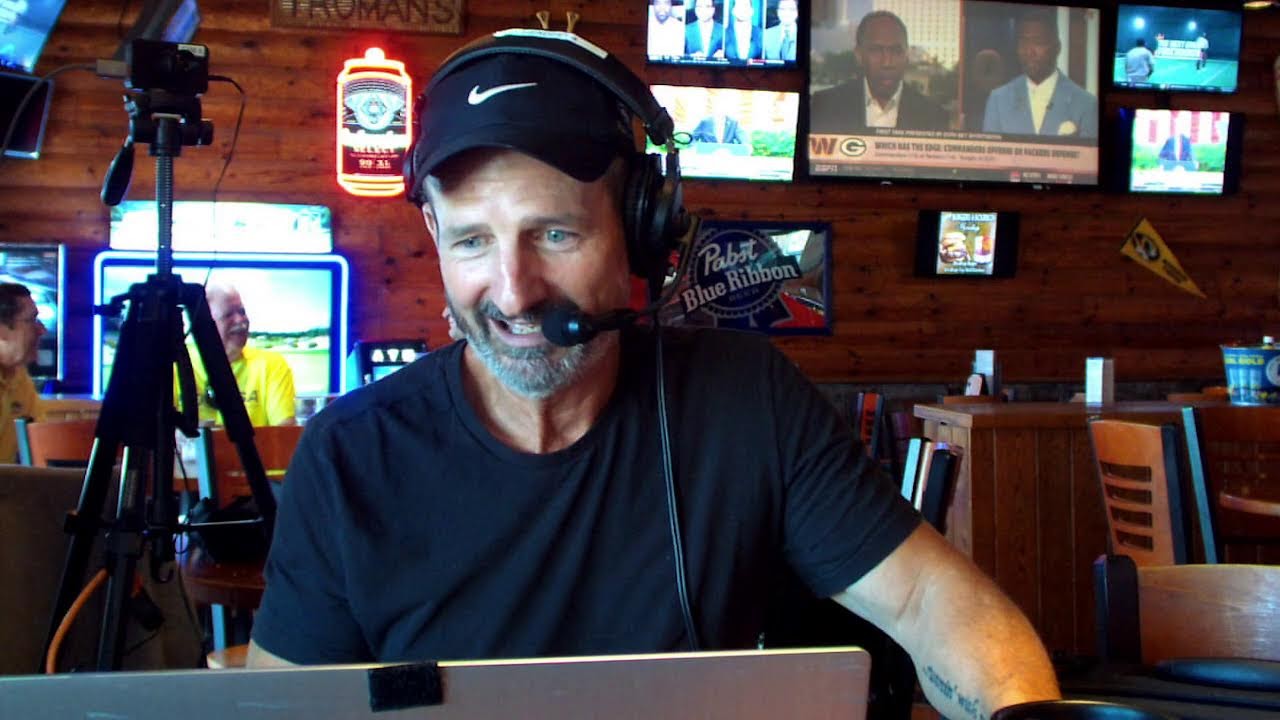
Whether we like it or not, he's the self-proclaimed governor of mid-Missouri, and he's the host of TTBS, the podcast. Since we can't shut him the hell up, here's Tom Bradley. Thank you, Nikki Garman. And it's hard. You can't shut me up. And actually, that's something we'll get into and we'll talk about in just a moment, as a matter of fact. But welcome to… We have a lot to talk about this morning, and I think this opening segment of the podcast is gonna be a little longer than usual, and I've already got this somber tone, and I can't help it. Ellis Bennis is to my left over here. Good morning, Tom. We texted yesterday, and we'll talk about that in a moment. We're live from Truman's Bar and Grill. Thank you, Cheyenne. And whoever's working… Thank you, Cheyenne. And whoever's working in the kitchen this morning, I got a fried chicken wrap. It was… What a great breakfast. It was awesome, man. Just delicious. Have you had it here? No, not yet. I'm gonna try it, though. You need to get it. Yeah. You need to get that thing. So thank you to Cheyenne and the group here at Truman's Bar and Grill. That's where we're here every single week. Family Focus Eye Care at famfocuseye.com brings you Keep Your Eye on the Crap, special this morning coming up at the end of the show on Keep Your Eye on the Crap, very special, in which we're going to… It is important, and...
Whether we like it or not, he's the self-proclaimed governor of mid-Missouri, and he's the host of TTBS, the podcast. Since we can't shut him the hell up, here's Tom Bradley. Thank you, Nikki Garman. And it's hard. You can't shut me up. And actually, that's something we'll get into and we'll talk about in just a moment, as a matter of fact. But welcome to… We have a lot to talk about this morning, and I think this opening segment of the podcast is gonna be a little longer than usual, and I've already got this somber tone, and I can't help it. Ellis Bennis is to my left over here. Good morning, Tom. We texted yesterday, and we'll talk about that in a moment. We're live from Truman's Bar and Grill. Thank you, Cheyenne. And whoever's working… Thank you, Cheyenne. And whoever's working in the kitchen this morning, I got a fried chicken wrap. It was… What a great breakfast. It was awesome, man. Just delicious. Have you had it here? No, not yet. I'm gonna try it, though. You need to get it. Yeah. You need to get that thing. So thank you to Cheyenne and the group here at Truman's Bar and Grill. That's where we're here every single week. Family Focus Eye Care at famfocuseye.com brings you Keep Your Eye on the Crap, special this morning coming up at the end of the show on Keep Your Eye on the Crap, very special, in which we're going to… It is important, and it has to do with crap, but it's good news. Good. It's good news. It involves crap. We've talked about almost every damn podcast. But good crap. No, no, no. It's good crap? No, no, no. The crap is bad crap. The crap is bad. But this is good news. What is bad crap? What is good crap? I don't know. I'm just hoping for some good news today, Tom. We're going to bring up the crap, and then there's going to be good news about the crap crap, the bad crap, that we've been talking about for some time. So that's coming up, Keep Your Eye on the Crap, at the end of the show. And today our guest is Boone County Sheriff Dwayne Carey. And is it me, or do you just feel safer when he walks in the room? Heck yeah, man. Right? I love it. He's such a gregarious, lovable guy. Unless you're a bad guy. That's what you want. He ain't going to kick the hell out of you. That's right. Switch it on. And that'll be the thing that happens. So we'll get into it. And we'll talk to him about a number of things. Shy hand this morning. He said, who's your guest? I said, Boone County Sheriff. She said, what are you guys going to talk about? I said, everything. It's been a while since we've caught up, so I want to get into everything. I want to talk about it all. And by the way, this whole thing about me sometimes talking too much, why do you say it that way like you're agreeing so quickly? We talked about this before. You had a diagnosis that you talked too much. That was not a psychological diagnosis. It was an ear, nose, and throat doctor. She put a camera down my throat. At least she told me that was a camera. And we went on from there. But last week, during our big announcement, I told you I was going to be doing a report on Fridays on KWRT, 1370 AM, out of Booneville, Missouri. And that's with my very good friend, Matt Billings. And I asked him beforehand, I said, are you looking for like five minutes? We're going to talk about what's going on in Columbia for people that are in a bedroom community of Columbia. You want like five minutes? He goes, yeah, I mean, whatever. Give and take. It'll be fine. I said, OK. So we went into it. We had a chance of fame last Friday with Matt Billings. Seventeen minutes, seventeen minutes. And I don't even know that I let him interrupt the whole time. As Deb's always said, I've always told you, you talk too much. He knew who he was talking to. He knew who he was asking for. I know. He knew what to expect. Thank you. I'm back on there tomorrow. We'll have a lot to talk about. You texted me yesterday because of news today. I didn't know when the news came out, by the way. And you texted me yesterday. I thought maybe it happened earlier in the day. I do not stay focused on incoming news. I mean, my wife texted me. I was in the middle of working. Well, I guess I found out before a lot of other people did. You texted me that Charlie Kirk. I hate the word activist on anybody unless I can't stand them. He's the founder of Turning Point USA. OK. Yeah. That's what I like. Would you call yourself a follower of him, of Charlie Kirk? Yeah. Did you know his age? No. But did you know that before? Yeah. I mean, I've heard him talk about when he got married, when he had kids, everything. He was shot yesterday. One of the stories says an apparent targeted attack. Apparent targeted attack. This is from the Associated Press, which I'm really going to bitch up a storm on them in just a second. I'll get to it. But I didn't realize until just now that I had copied from this and pasted it. An apparent targeted attack. What do you mean? He's speaking to a group of hundreds of people on a college campus and somebody from hundreds of yards away put a round through him. And by the way, I haven't gone through report after report and video after video on this. After you texted me, I was with a group of guys who get together every other week at Baroque. We talked about this before. And boy, I, it was, we were all in a mood. I think there were a lot of people going through that. I am not what you would call a follower of Charlie Kirk. I'm aware of him. And I'm not saying that I chose not to follow. I'm just saying I was on the peripheral. The most I've ever heard of and about Charlie Kirk has been in the last 18 hours because of what happened yesterday. He was assassinated. When you texted me, did you know that he was dead? Or was he? When I texted you, they had not pronounced him dead yet. No. So we were, we were praying for him. I literally was on a video call with a client and we stopped and prayed for him during that time. My wife was at homeschool co-op. They had a prayer time for him as well. So we were really hoping that he was going to pull through. Authorities, and I share from this Associated Press story this morning, as of two and a half hours ago, seeking a new person of interest in the shooting of no one in custody as of late yesterday, according to a law enforcement official. If you have anything updated on that, I don't have that in front of me and I cannot go look for it right now. The event was at the university, Utah Valley University is the name of the school. UVU, as I was referred to, has been met with divided opinions on campus. The event that was going on, not the shooting, but the event that Charlie was going to be there speaking. An online petition calling for university administrators to bar him from appearing received nearly 1,000 signatures. From what I understand, he was someone who was trying to bring together people for discussion. Is that correct? Absolutely. His most famous phrase was, people would ask him, why are you doing this? And he would say, I'm doing this because as soon as we stop having human connections and we stop having conversations, it makes it much easier to commit violence against somebody else once you've dehumanized them. Well, I think we've stopped that on a number of areas a long time ago, and you've heard me talk about it here since we started this podcast. It is a change from what I was doing on the show, and I'm not telling you that I did some 180, and I'm not telling you that what I'm doing is perfect or anything else. I'm just saying, I think we need to talk more because I'm really happy about some things and I'm really pissed off at some things, and my happiness or my anger doesn't spell out what we need to do, and I don't have all the answers. If you put me in charge of the planet right now, I don't want it. I know there's some people out there that do want that, and I'm going to tell you right now, they don't have all the right answers either. It's going to take all of us, and even then we might mess up, but we have to have that. You're a fan of Charlie Kirk, and so you could say that. Would people that disagree with him say, no, he didn't want to talk, he just wanted to yap at us? Because I don't know. You tell me. And don't forget, you're in charge of the switcher. Yeah, so we watched, there's all these clips where people would be like, oh, you're just here spreading hate, and he'd say, what am I saying that's hateful? You're just here spreading racial bigotry, and he's like, what have I said? And they never have an answer for him because that's not what he was about at all. There's a couple soundbites that you're going to see show up on social media of what would seem like crazy things that he said, but if you will go back and watch the clips and put them in context, it'll make a lot more sense, just like anything else you take out of context. It's easy to get the wrong idea. One of the differences of doing a podcast as opposed to a daily radio show, which I'm still not just trying to learn, but also trying to get used to the whole thing, is that when you have something so real and so fresh in our minds right now, I can't go on and pretend like it doesn't exist. This is live, very real. Someday tomorrow, or a year from tomorrow, you'll play this podcast back, and you'll be like, why'd they spend so much day talking about this guy? I don't know. It's okay. Just ignore it. Fast forward. You can do that if you want to. I want to share the tidbit from the Associated Press story that I read this morning. The shooting comes amid a spike in attacks on political figures in the United States across all parts of the ideological spectrum. Why did you put that in there? See, if you don't smell a genitive from the Associated Press, well then let's go a step further. This is the very next line. The victim, 31-year-old Kirk, personified the pugnacious populist conservatism that has taken over the Republican Party in the age of Trump. Now, I don't know how many trigger words you could put into one goddamn sentence, but they certainly did. Pugnacious. Let's look up the definition. Shall we? Adjective. Eager to, I'm sorry, eager or quick to argue, quarrel, or fight. That's the label they put on Charlie Kirk. Now, I don't know him, as I told you, and I'm certainly not defending him, but that was the first thing that you put on there. It goes on, he launched his organization, Turning Point USA, in 2012, which would make him how old? He's 31. When he started it? He was a teen. Teenager. Do you want me to tell you what I was still doing at that age? I'd still be doing it now. Venturing into liberal-leaning college campuses where many GOP activists were nervous to engage. Pugnacious. Wow. The Associated Press has been leaning to the left for a long, long, long time, but they have generally had some level of professional guide that they have followed. It just continues to fall further and further away. And if you're going to mention someone, whether it's a Donald Trump, or let's say that it was a Joe Biden, you have to put a caveat in there where you mention Joe Biden, Joe Biden, President of the United States, who is older than dirt. No, you would never do that, and they never did. So damn you guys for being like that. What a shame. And his blood's still wet at the event site where this took place out in Utah. It's unbelievable. Almost all the articles that I saw, they started with Trump ally Charlie Kirk, or Charlie Kirk Trump friend. And maybe he is. Maybe he is. Maybe he is. But if you died tomorrow, should they say, person who voted for Trump, Ellis Bennis, was shot today, if it has nothing to do with why you voted or somebody was yelling at you about how you voted, why would you put that in the front of that thing? I think you know why. That's really, you guys, this is what we're talking. It's not discourse. And it's flooding across you while you're watching social media, while you're if you're catching news on television or on radio. It's flooding across you and you don't know it. What is the right thing to say? You tell me. You become the journalist. Take a look at something that happened and say, what should you say? Today a guy was struck by a Ford F-150 and killed on the road, which, by the way, is our nation's number one selling vehicle. Really? Do you put that in there? Are you kidding me? If I sound emotional about this, I am. And it's not about Charlie Kirk. It's about us. Yeah, it's about what we're doing. Meanwhile, my heart breaks. It is so hard to not feel a load of empathy at someone who is younger than all three of my own children. He has two little angelic babies that he leaves behind. And it's really, really, really upsetting all the way through. So I know I know we have to move on and I know I've taken a lot more time on this thing than I wanted to. I guess I can apologize for that, but I don't think I'm going to. I think I'm just going to move on. I think we're going to I think we're going to release the hounds. When I say release the hounds, I really do mean release the hounds, because Creekside Pet Center and Bed and Biscuit and Dirty Harry's in Boonville are all releasing the hounds and so are we this weekend. It is their pet-tacular. They're celebrating their 10th birthday at Creekside Pet Center. That's impressive. We're going. And so is Daisy Jane, the sweetest dog in the world, unfortunately. And there's a dog park there that you can let the dogs into and they're going to run around in the fenced area. Everybody can bring your dog. Daisy Jane will not be released into the dog park. She's still on the and don't take this the wrong way. This is the tail end of her reproductive season. And so she'll be only shared that very awkward start of that on the show. She will. She'll be on a leash and but she'll have a great time. There's a beer tent. There's food trucks all over the place. There's probably face painting and face painting and clowns and balloons. And what else is there? Food trucks. Did I say that? It's worth mentioning twice. Yeah. Bounce houses. There's a photo booth for you or your pet or all of y'all at one time. There'll be a petting zoo with every animal you can imagine set up out there. I understand there might be a Zebu and others like turkeys. A what? A Zebu. You got to go. If you don't know, you got to go. I'll have to take a guess. Go there and check it out. Zebu. Adoptable dogs. They're all the proceeds from the Pettacular going to animal rescues this weekend. And live music. It'd be enough if I said there's going to be a live band there. There's two. Oh, nice. We're going to have Creekside Revival. Got to see them last week at Pierpont. You guys did a great job. And my good friends at Sea Rock City there as well. It is this weekend. It's coming up Saturday at Creekside, 10 a.m. to 4 p.m. I hope you get a chance to make it out there because we've already got our decision made up that we will be there. Cool. And that Daisy will not be allowed into the dog park at this time. All right. You want to go back to camera four at this time? Yeah. All right. You're the switcher. You're doing a hell of a job over there. I want to say good morning and welcome to TGVS, the podcast to our guests. And that would be Boone County Sheriff. And I texted you yesterday and called your brother. Was that OK? Sure. We're tight. OK, I want to make sure. All right. So. So in the future, when I get pulled over by a deputy, Boone County Sheriff's Department, I'm going to say, you do know that Dwayne Carey is my brother. They're going to say, well, I can see who got the strength and who got the hind teet, if you will. Good morning, my brother. How are you? I'm doing well. Doing well. Hey, can I jump in on your conversation? I had a feeling that you might want to. Yeah, absolutely. I'm pretty vocal about local media and how I think law enforcement is depicted here locally. And so, you know, one of the issues I have is, you know, they'll read a probable cause statement that the law enforcement has done and they use the word alleged, very similar to what you were just talking about. Like our words are not true. And so it's alleged. And then the other thing that really chaps me, and this just happened the other night, you know, we unfortunately had a tragic deal up in Harrisburg where we had to shoot and kill a guy. And so they interview everybody that is talking about how, you know, this person's a great person going to be a doctor, you know, all that kind of stuff. And then, you know, they'll have someone, well, why didn't they use like a stun gun or whatever? So you immediately, my deputy is armchair quarterback because of the direction that the media person wanted to go in. And that troubles me very much. I've already cut off several media outlets. I love podcasts. What do you mean by cut off? We don't talk to them. That's it. That's it. They can go to our Facebook page and they can take what the PIO is putting up. But we do not do interviews with them because they continue to get the stories incorrect or they're trying to shine us in a negative light. And I don't, I don't appreciate that. You know, the damnedest thing is I can't tell if they're trying to or if it's become second nature, just like natural. Yeah. And some of it's an experience too, Tom. I mean, when you think about some of the outlets that we have, you know, where they're using journalism students or whatever, but, you know, the thing that troubles me is then if I'll call, if I take the time and say, hey, I want to call and talk through this and then they don't want to talk to me about it, then yeah, I'm going to cut you off and I'm going to move on. Here's what happens with a story. All right. Because the, the real news that broke, the reason is something we would bring up and talk about is because one of your deputies shot and killed a man. Where did you say it was? It was in Harrisburg. In Harrisburg. One, one night earlier this week. Right. That's the story. But what really happened started before that. So but if we start with that as being the entire story, it's like, why'd you guys shoot somebody? What, what was wrong with you? Why didn't you use a stun gun? What was going on? Like, hold on a second, because that is a big deal. But what was the person doing before that? What led up to what happened at that very, very moment? And of course, it's not only going to be, it is being investigated. And of course, this is under the jurisdiction now of the Missouri State Highway Patrol. So it's like, back off, guys. Right. Back off. I mean, let's, let's start this thing and try to understand it. Right. Yeah. And you know, and it's, it's been a shift over the last, what, 10 or 15 years. I think it really started around Ferguson in 2014. In fact, that's when I started pursuing, you know, national accreditation. And the reason why is, and I think you guys would agree with this, 20, 25 years ago, if the sheriff said this, it was gospel. Right. That's right. And now it's, it's not gospel. I mean, again, it's not all of society, right? The silent majority is agreeing with, you know, everything that we're talking about this morning. But, but there is a part of society that doubts what we say and doubt what we do. And so you have to have that, that higher authority, you know, to say, no, they're, they're doing everything right. They've got all the policies in place. They, they operate within these policies. In fact, over in Callaway, Daryl Mailey has achieved a CALEA accreditation. He's now pursuing Nigel in the jail side. So it's something that we're recognizing as law enforcement managers that it, especially with the media and part of society, our word is no longer good. So you have to have this national authority to say, yeah, they're doing what they're saying. They're doing. And it's the same for these media outlets that you guys have felt almost obligated to cut off. Because as I was talking before you got here this morning, you're one of the most readily outspoken law enforcement people I know, because you know what you're talking about and you're ready to share it with anyone who's ready to listen. Here I am. You know, you're still the only one. I told you this almost a year ago. You're the only one in law enforcement that really wants to talk about that. We have gang activity in the area and we've had, and you've been mentioning it for what? 20 years? Yeah. And we've got people, the Columbia Police Department has trouble saying we have gang activity. Why? I don't know. That'd be like saying we don't have human trafficking or drugs or road rage. We have it all. We don't have homeless. We don't have people crapping on sidewalks. Speaking of keep your eye on it. What did I just step in? Exactly. So, so I appreciate from you. And that's why it's such a shame that you had to cut somebody off. It's like, you guys, he's giving you everything. You're, you're ready to give somebody all the information they need. Yeah. And that's why I've always had a great relationship with you and other people that were in radio because when I'm on radio, it's coming from the horse's mouth, right? There's no taking me out of context, which you mentioned earlier. And so you either like what I'm saying or you don't like what I'm saying, but you're getting the actual words and what my intention is to where print media, television media, they're taking bits and pieces of what your quote is, taking it out of context. And then, um, boy, it's just, it's really aggravating. But when you guys started that conversation, I immediately went to the other night thinking about you're doing this to my young deputy who did an excellent job in a very dangerous situation, split second, awesome decision. And now you're going to arm chair, fricking quarterback him with the words that you're putting in your, in your print me. It just pisses me off. And that's where you are right now in what you know, and your view, if the highway patrol comes back and says, actually, Sheriff, there are some major problems in this thing. You're going to say, well, let me see the investigation by all means. Let's know what's going on. And then you may agree with their findings, disagree or question it or whatever. So for the sake of while it's on the table, what would you like to tell us about what happened the other night? Well, obviously I can't talk about it a whole lot, but what I think it's, what's important for listeners to hear is that, you know, obviously when we get that, I'm responding along with other members of my command staff, right? We have body cam now we have in car, we can take a peripheral, you know, a quick look at that. And then I know, okay, hey, are we going to have to own something or are we not going to have to own something? Of course, I'll always call the highway patrol on stuff like that because I want an outside agency to, to investigate it. And I could use Callaway or whoever, but we've had a great relationship with the patrol over the years. You know, Colonel Turner is a longtime troop F commander here and Lieutenant Colonel Wallace Aaron used to work for us. So it's a good relationship, but we're going to go and get kind of a quick look. We obviously do our own internal investigation of that as well. So we activate our IA team and then they start the IA. So I already have a pretty good idea where we're at in that. The patrol will run their course and do that. You know, and I've already mentioned it, right? Excellent job by my young deputy. I mean, just a splendid job. And that's why it bothers me when, when law enforcement in general, but in this case, we're getting armchair quarterback on something that people have fricking no idea. And I thought about you two the other day when we were talking about this internally. You thought about me and my gun. Is that what it is in the training? Yeah. Yeah. Tell everybody. We do some scenario based training. We used to do it over at the old fairgrounds and now we lost that. It's the city of Columbia. So we're building this big old training center, which we could talk about here in a little bit, but we want to continue doing that scenario based training, not only with us, but with all of our regional partners. But when, when I was trying to, it was, I think it was around after Ferguson where we're starting to get armchair quarterback in the profession, right? So I'm just talking about how tough it is to make those split second decisions. So some of our media friends, obviously Tom was one of those. I invited up to go through our scenario based training to where it was traffic stops. I think is what you were doing. I don't know if we got into building search, but I think you did like the simulation fats and then we went into the traffic stop. Can I ask, are these where you're like looking at a video and then you have, no, it's real people. So, so much like paint gun, right? Yeah. So, so we'll put in, you know, a simulation type weapon. Tom had a gun belt on and all of that. And so he is the deputy making the traffic stop and we can set up whatever scenario we want. We pull into the arena and it's darkened in there to some degree. I've got my lights on, I'm on the radio, radioing back and forth and I've pulled over a car and now I get out of the vehicle and that's, and here's where, and by the way, they've set the scenario for me on who I'm pulling over. Do you remember what the scenario was? Was it the phone scenario? It ended with that. Yeah. It was that he, um, was wanted in questioning for domestic assault. Oh, okay. And so what, what we know is that a woman back at her home has been assaulted. And this guy, husband, boyfriend, whatever, acquaintance is, is said to be responsible. And we have now found him on the road and we're pulling him over. So I've just pulled over the car that's matched up to him and, and now I get out and what does he do? Do you remember? I think he's going to make a phone call if I remember. Well, he got out of the car and I said, sir, there's no need to get out of your car. Would you sit back in? And he starts yelling at me and he says, what did the bitch say? Right. Okay. Oh man. So this is a person you're facing, probably another law enforcement officer or an actor. 6364. He was way up here like this and, and he's, and he's yelling at me, dude. Even though you know this is fake, that still gets your adrenaline pumping, doesn't it? Yeah. Even for law enforcement, it still gets you pumped up and you know that you're just like, I know this guy's an actor. Yeah. He's doing his job. So, so he, so he, he's takes a couple of steps for it, sir, stay where you are. And at this point I reached back and I put my hand on the weapon and I said, I need you to stay where you are. He keeps yelling. He keeps taking more and more steps toward me and he puts his hand in like a jacket pocket because he goes, cause I'll tell you, I'll tell you, man, I'm not going to put up with this. I'm not going to bother. He keeps walking. Sir, stop. And he yells again and he takes a firm stance on the ground and he yanks his hand out of his pocket with something in his hand and I put a round dead into his chest. Just like that. He started laughing his ass off and he holds up and he goes, there's a phone and I'm like, oh my God. It's tough. Right? So how bad was I? You were good. I mean, compared to a lot of people that we've had, you know, do that. And so, so then you have to wonder, I mean, are you going to try to get all media through that? Especially some of these young folks, because they just simply do not understand how it actually works. And so, um, you know, we could go into like a bunch of different paths with this, but you know, the co-responder thing with mental health and, um, you know, but what are you going to do with a guy that's naked and swinging a sword? I mean, you know, it's just, it's just, you know, so, uh, what's the context? Was he at a renaissance fair or was this a traffic stop? And keep in mind, like those in glass houses, if you're naked, don't be swinging a sword around. Am I right? That could, that could be dangerous. Because we, we spend a lot of time getting our folks trained up with crisis intervention, you know, to where they can deescalate. That's kind of a word of the day. So I mean, we truly, I mean, I have a motto at our place that's just treat everybody like you'd like your mother to be treated. It's really fail-proof if you think about it. Right. So, but we train our folks in deescalation. Deescalation and CIT because part of this scenario-based training is we want them to use their words and be able to talk them down. But sometimes like in the case that Tom just described, they're not listening to what you're saying and they're not following directives. At some point, the rubber is going to meet the road and you've got to make a decision. And so, um, anyway, uh, yeah, I thought about you with that and I, I know I took us off on a tangent, but when you guys were talking about that, man, that fired me up right away just because we've been dealing with this the last couple of days. I think it's a really good thing to talk. I mean, because, because law enforcement officers, unless they're a bad apple in there, you can have them out there in any profession. And unless that's the case, they would like the guy that they're trying to deescalate the situation. They'd like him to break down to his knees and start crying and calling for his mama. And that's the end of the day. And then they take them away kindly and they, and we start taking care of the situation. Not having put a round into somebody and they're dead. Yes. I, you know, I just, just drawing your weapon out there has got to be more than you'd like to see happen on any given workday in law enforcement, right? Right. And that's why the scenario-based training is so important. And I've talked about this a lot over the years too, but, and I always use the universe, university of Missouri football team, but you know, all week long, they're putting scheme in there, watching film, uh, you know, what plays are we going to run against this defense that we're going to see on Saturday for us? We never know when that's going to happen. Like we don't know when the game's going to be played. It could be Sunday morning at 3 a.m. or it could be today at two o'clock in the afternoon. You never know. So we have to do that scenario training. And then that's one of the things with this training center is not only for us, but I want to make sure that all of our law enforcement in central Missouri has that ability to be able to get that type of training to where they have something in the back of their head they can draw upon when they're out on the street. So we're kind of opening this up to Calloway and Audrain, you know, Randolph, everybody around the central Missouri area, all the way out to Montgomery County. And then municipalities as well. And so we're going to allow them to come in and we're going to do this type of training to make sure. Because when you guys, when you think of even like Floyd, there's a bunch of different cases that we can look at nationally. A lot of it is a training issue. It's nothing more than a training issue. If you covered that type of training in your DT program or whatever, defense status program, you're going to address that. And then the other thing that you said, Tom, that anybody in my shop would tell you, if we have a bad apple, that bad apple doesn't work for us. That's what I was going to say. I want to brag on our law enforcement and say this, and you can correct me if I'm wrong. I don't know a single law enforcement officer that ever wants to pull their gun. And I don't know a single law enforcement officer that is ever happy about having to take a life. I've never met one. And I think you would back that up, right? You guys hate having to pull your firearm. Like what Tom said, we want them to stop, listen, and we want to deal with the problem. Like that guy, I mean, you have the gun drawn on them. They're not in a rational state of mind. If you have a gun being pointed at you, immediately normal people stop and we're like, oh, let's reconsider my life choices. The guy's still yelling at you while you're pointing, it's like, there's something wrong. So I just want to back up our law enforcement to say, none of these guys want to take a life. They hate it. They hate it. It's going to put them under a microscope. They're going to get ripped apart in the media and it's not fair. And so I just want to back up our law enforcement to say that, like, it's garbage. They don't want to do this. They agree. Yeah. The training you guys provide, everything else that you have to oversee, I mean, it's a lot of responsibility as the Sheriff of Boone County. And there's a bunch I want to talk to you about the fact that it's been so long. You were running for reelection the last time we had you on the show. Is that right? Yeah. Last fall, maybe October. Yeah. Yeah. 20. Yeah. And you won. I told you you'd win. I told you. I told you. You, this is your sixth term. We don't term out as the County Sheriff. You can stick around as long as you like. I had this horrible fear that you were going to not seek reelection. Like, if you go back, like, two years ago, I'm like, man, he's just going to he's going to leave. He's going to leave. And and you said, no way. I think this is long before the election came up. You're like, no, no, no, no. I will be running for reelection at least one, if not two more terms. Right. You're in that sixth term. Will you be seeking a seventh? I'm sorry to ask. No, I will. Yeah. And I've been pretty vocal about that simply because we've got so many big projects going on that, you know, once the building is built and, you know, we have an indoor gun range, we have three live shoot houses. Once you have all of that, you've got to make sure the concept is carried out. Right. I've made a lot of deals with all my partners that this is the way it's going to be. So I've got to stick around to make sure that the concept is solid and in place. And then, you know, we're obviously we've got people that we're doing succession planning with in a variety of positions to include mine that will then want to transfer all of that over. But I want to make sure that it's going full speed ahead before I walk away. You know, you serve the entire county, but the biggest base in their population wise is Columbia, Missouri, which is extremely boy, I'm not even sure if I want to say what Columbia is, but it's different than the rest of the counties to some degree. I understand that. That's your biggest voter support, though, also is coming out of Columbia. Administratively, if you were running a popsicle stand, you're doing a hell of a job with it. But you're in law enforcement. And I would say from everything we can gather, you're doing a great job in being the top law enforcer in Boone County. And I think people in Columbia know that. Why do you think we don't have that being reflected in other agencies, agencies we have that are in Columbia? Why? Because I don't think we do not just law enforcement, but a lot of other offices in Columbia. Why is it different? Well, first, I appreciate the kind words I, you know, for us, I'll speak for us. But my strategy over the last 20 plus years has been kind of fly under the radar. And it goes back to the old saying, no news is good news, right? And so, we don't do a lot of fluff about ourselves or anything else. I mean, we just kind of, like, you would be shocked on how many great cases that we make. Drugs, guns, everything else. And we never even release the information. I mean, we do the report, make the arrest, send it to the prosecutor. But we don't do a lot of reporting on a lot of the good stuff that we do. And so, you just don't, when you don't hear… Why is that? It's just a strategy of mine, you know, and I don't know that I actually thought of that strategy. I don't know that it played out that way to where our job is not to impress anybody. Our job is to enforce the law and do what we do and do it well. And I've got a great group of people. But, you know, you get into, like, smaller, smaller agencies, especially, and, like, you go to their Facebook page and they made a warrant arrest for failure to appear. But they put the person's picture up there and, you know, so all that stuff that we do, we just kind of do it and do it under the radar. And so, I think people kind of forget that you're even around. Like, there's a lot of people that maybe don't even know who I am because I have a PIO now, Brian Lear, that does a lot of our media stuff. And that's okay, right? Because I'm working, my job is to manage the entire agency, right? But I'm also succession planning. I'm trying to get people to a place. I mean, I'll give you an example. My chief deputy, I loaned my chief deputy to 911 when the presiding commissioner made a decision that he was going to move a different direction on the director, which giving my chief deputy to 911 allowed my captains underneath the chief deputy to then grow in their position. So I could give them more stuff that they hadn't done before to where they're now becoming better in their position. That's what it's all about, right? And so, I don't know. We just, to answer your question, I think it's just, we do a really good job. I've got great people. It doesn't have anything to do with me. I've got great people. But because we don't really talk about ourselves a whole lot, I think that that's how we kind of fly under the radar. This is going to be a weird question, but you have enough experience, you might be able to answer this pretty easily. Let's say that you were going to take over another law enforcement agency. Let's say that staff-wise, it was approximately the same size, okay? And you know that there's been major, major problems, that the public's not feeling safe with them, that there's an issue with the media out there also. There's been some accusations of some under, whatever, whatever. It's not good, right? We've got to fix this thing. If you walked in, what would be your first step? So the very first step, and I tell a lot of people this, right? If you're inheriting a train wreck, you've got to be in the building, right? There are no vacations. There are no days off. You're in the building letting everybody that you're leading see you. And that's where a lot of people in leadership roles make mistakes. I've seen it over and over again. But every new leader in this central Missouri area, that's what I tell them, is you've got to get in the building, and you're going to start addressing issues. But the important thing is they've got to see you in the building. They don't need to hear that you're down in Mexico on a freaking two-week vacation, right? You need to be in the building. And so I was very fortunate. I inherited a really good department from Ted Bame. But the lesson that I learned is, as soon as I was elected in 2004, so in 2005, everybody wanted me on their board, right, because a newly elected sheriff, and, hey, can you come sit on the back board, and can you be on this board? So what I noticed immediately, and again, I had a good agency, right, is my employees were wondering, where the hell is he at? We don't ever see him, right? So after one year, I made the decision, it's more important for me to be, and again, it's kind of a quote-unquote political position, it's more important for me to be in the building than it is for me to be on these boards and seeing all these constituents and glad-handing and doing all that. So I mean, literally, I just called about 12 or 13 people and said, hey, I'm getting off, you need to replace me. I met with all of my staff, because I could hear their questioning, and ever since then, I'm freaking in the office all the time. And so, I mean, I just took my first vacation in two years to put in sewer pipe at a new house. What a romantic at home, you know? She's like, oh, this is great. And to build the fence around my lagoon. But the reason… Wait a second. We went to St. John. When we talk about lagoons in St. John, I'm talking about Cruz Bay, all right? No, no, no. You're putting a fence around a lagoon, along with the property. Wow. And the reason for that is we have big projects going on, right? They need to see me there. And then, you know, I do a lot of work down at the Capitol. And they understand that, you know, like I'm going to the Capitol, because a lot of that is for law enforcement as a whole, or for sheriffs as a whole, or whatever the case might be. But that's what I tell them. That's the biggest thing, is you've got to be there. And so many people, when they get elevated, I've seen it over my career. Even like, you get somebody into a… They've worked really hard to become a canine handler. And then they become a canine handler, and they've reached that pinnacle. Now all of a sudden, they're freaking not productive anymore, right? Or they got promoted to lieutenant, and now they're not the same person that you saw when they were a sergeant leading the squad. And so I've seen it… It's getting the carrots. That's right. Relax. Yeah. And so these agencies that are inheriting a train wreck, I mean, you know, I talked to Roger Johnson about this, the prosecuting attorney, a long time. He's done a really good job in the short amount of time that he's been there. But I'm like, you've got to quit freaking trying cases, and you've got to be a manager. Because he took over an office that was in a little bit of some shambles at the time. Yeah. And so you've got to quit preparing for cases in a closed room with your door shut. You've got to be out in front of your staff, and you've got to have other people trying those cases. And I think he ended up, you know, asking the AG to help with some of those big homicides. They were bringing attorneys up. And Roger's done a really good job of trying to transform that, but he did it by being in the building. I saw something the other day. I want to ask you about crime locally and how things are going. But let me go into this direction. Because I just thought about this. After you… And I didn't give you much time that you were coming on this morning, so I apologize for that. Oh, no worries. But after we talked and you were going to come on the podcast, I was like, I wonder what you think about Trump bringing troops into different cities, and what would it be like for you if that happened in Boone County? Let me share the story that the president deployed the National Guard to Los Angeles in June, sent them to D.C. in August, threatened to send troops to other Democratic-run cities, including Baltimore, Chicago, New Orleans. Lawmakers from Louisiana, a red state that surrounds a blue city of New Orleans, said it was a great idea for National Guard troops to go there next. And I say it like that, I kind of give it emphasis, because of Columbia sitting in the middle of not only Boone County, but also in central Missouri, which is very, very red. So how would it feel to you if the president said, I'm going to send some troops into Boone County? What would that feel like? It would not feel good to me, right? Because that would tell me that I'm not taking care of my business. And there's a lot of people, I mean, I can't tell you the number of groups and people that I've spoke to about immigration, all of that. Because people are really nervous and uncomfortable, especially in the city of Columbia, right? And so obviously Chief Schlute and I talked very early on about, hey, what's your policy in the city? What are you guys going to do? Okay, it's the same as what mine is, right? And so if ICE rolls into town, we're doing the same thing that we're doing. Our job is to enforce the law for people that are committing criminal violations. We're not going out to a Walmart parking lot to say, hey, you got a green card. That's not our job, right? So ICE could roll into Columbia, Boone County. They're not going to, but they could roll in and they could do that work. But we're not going to participate in that. Can you back up to that and explain to people, you said it's not your job, right? So you would help enforce it if somebody said, hey, we've got an issue going on here. But you don't go around asking people for green cards. No, no. Because I don't have one. So we're only pursuing those people that commit criminal violations. That's what our job is. As sheriff deputies, we enforce state law. And so we're not interested in the roofing crew that might not have everybody. Some of them have come up from Mexico or wherever they might have come from that are working here every day. We're not interested in those individuals if they're not breaking the law. If they're breaking the law, we get a lot of interest in them, right? And if they come into the Boone County Jail, and we've had this for decades, as long as I've been there, for 35 years. But if they're in jail, then we'll notify ICE in Kansas City, and then ICE can make the determination whether they're going to come down and get them or not. But we're not… That's because they committed a crime, allegedly. You arrest them, bring them over to the county jail, and then you're like, this person is not a legal resident of the United States. And then you reach out to ICE, and they start figuring it out from there. And then the prosecuting attorney will decide, are these local charges worth pursuing, filing, or are we just going to turn them over to ICE, and they'll come get them, and then they drop the state charges here locally. But yeah, we're not… Everybody thought that they were going to roll into town. The other thing is, I think from the outside looking in, Trump's looking at Chicago, New Orleans, these places that they're having frickin' 80 homicides. And the problem is, a lot of that is just big city liberal problems, right? To where they're not… Go back to Minneapolis. But Columbia is not that case. We've got a bunch of juveniles that are shooting at each other, but we're not out of control here, right? And so the city has picked up a lot of their traffic stops. I look at numbers every morning. And so we're starting to get more proactive as a group. We've got a new street crimes group that we call our Directed Patrol Unit. And so, I mean, I think we're kind of on the uptick here in Columbia, Boone County with the work that everybody's doing now that I wouldn't have said that and didn't say that to you many years ago. Yeah. When you say many, we're not talking many. Right. Right. Only just a couple, few years ago. Yeah. And we were seriously having these discussions. Right. And you said, we need to do more. Right. You said these liberal cities, Chicago, Los Angeles, apparently New Orleans, which I've never even thought about before, but it's a blue little heart in the middle of a red state of Louisiana. I hear what you're saying. Answer me this. New York City. Very, very blue city, right? Well, back in the day when they had crime out of control, they had a mayor that stepped in and said, we're going to help clean up some of this stuff. And that started happening. Right. It's almost like the criminals were reading the paper. Oh, look at this, Louie. What is it, Harry? They're going to start cracking down on us, man. Oh, no. Like they were paying attention. Crime started being reduced in New York City. Well, I don't even know what we're talking about, 30, 35 years ago. And I'm like, it was, it was working. Okay. Like, how come we don't, how come Chicago isn't looking at it going, you know, another city did this a long time ago. They fixed it. Maybe we should do that. How come? Right. So it's called broken windows. Giuliani. Right. So, and you've heard City of Columbia has used that term here recently, broken windows. So it's basically, you're focused on all the little stuff and you're starting to enforce all the little stuff to keep the big stuff from ballooning and happening. Right. So New York City did that. Very successful. I teach a couple of classes for Columbia College online. And I talk about this point exactly. Very successful, but it was deemed a racial disparity. Right. Because where they're working in those high crime areas, it was predominantly, you know, black youth that they were arresting for these minor things. And so the disparity index was like through the roof. And so eventually New York City backed off of that. But when you look at during that time period you're talking about, crime went, I mean, plummeted. Right. Because they were super aggressive, super proactive, and they had a handle on it. I think, and again, I haven't talked to anybody at the city. I think I've heard that term maybe a couple of times here in the last month or so. And I've seen the traffic stops pick up. Right. And I think they're trying to get a handle on all of that. They're getting more cops now. They were, you know, down a lot of cops. They're getting more cops, getting them downtown. I think the university is probably taking some heat from some parents on, you know, the shootings downtown or whatever. And so, but yeah, I think overall, I mean, I'm pretty confident to say that we're like on an uptick. You know, the only thing that I wish we had more of, and it was after the Second Amendment Preservation Act passed, the initial SAPA, you know, where we had to like end our relationship with ATF. We were doing all the good work on federal indictments for a lot of these gangs, which is just, you know, crazy that they won't talk about it because we've had it, you know, forever. Right. You know, and so, but we lost the ATF. They went back to Jeff City. We still have a good relationship with Charlie and crew at the ATF. But yeah, if there's more working together like that and more indictments, but right now the biggest problem that we're having are these juvenile shooters. So you mentioned the disparity problem with the broken windows, right? So let's go back to that thing, because I do think things come in waves, right? They go in cycles and someone's going to say, this is good. We're focusing in on some problem areas and we're stopping it when it's early and young, when the problems are and the people committing them are young, right? Well, it becomes a broken taillight thing then, right? Because now we're going to be stopping someone for broken taillight. And yes, those with a broken taillight are a little bit more apt to commit violations and crimes than those people who don't have broken taillights. I know it's stupid, but it's a reality. And we have a racial disparity index when it comes to traffic stops in Columbia and then in turn in Boone County. And so we're going to have, if we were working on these small crimes and working on whatever it is, we can call it the broken taillight thing. We're going to wind up with that disparity index, which we see annually, it's going to get worse again, which it's bad still. Yeah. And again, I don't know a whole lot about this. I don't think I'm speaking out of turn, but so, and you guys remember there was a little bit of a banter about the jaywalking citations that the city did. Yeah. I was watching it on Facebook. Yeah. Yeah. And so that's kind of like broken windows, right? Like, Hey, we're, we're asking you to leave. We're having a lot of shootings and a lot of fights down here, especially at two 30 in the morning. You're not, you're not dispersing. You're not leaving. So now we're going to start writing paper or we're going to contact the juvenile office. And again, this was not your team, but there were city of Columbia police officers and these people were congregating in the roadway. Yeah. To my understanding, that is correct. And they weren't following directives, right? So the Sergeant on the scene decided, okay, well, we've got to take action if they're not listening to what, what we're saying. And I'm just basing this off of, I heard chief Flutie kind of explain why they were doing it. But at this point, and the reason I bring it up as a part of this broken windows, right? That seems to be a very minor deal compared to a lot of other things. So the person on the outside looking in and thinking, what the hell are they doing summons for jaywalking? Right. But they're doing it because they're trying to get control over the crowds down there at two o'clock, two 30 in the morning when the shots are fired and the fights break out. And so it's a, it's a law. I mean, for law enforcement, it's easy for us to understand that. Right. So, you know, for me, I'm like, I'm applauding, Hey, good work CPD. And you've got to start taking care of some of that small stuff. But you know, some people on the outside are not viewing it the same way. And that is the way that it goes. Ellis, did I bring up on the podcast about when I did the ride along with the CPD, whatever this is now, 23 years ago or something about the guy that we had to arrest for, for like jaywalking? No, I don't think so. But I mean, this literally jumps back to what you said at the very beginning of the podcast. They're like, Oh, they're, they're signing up, writing them citations for jaywalking. What was happening before that? Right. Right. It's ridiculous. You got, I've jaywalked hundreds of times. I have the liar, liar scene in my head where he's screaming into the phone, stop breaking the law. You know, it's like you won't get a ticket. This is, I mean, the ride along was really interesting and I learned a lot that night. Who was it with? Was it CPD or? It was CPD. Yeah. Okay. It was, it was right after we had the pyrotechnician, pyrotechnic explosion at a concert in, I want to say Jersey. And many people died in this overcrowded nightclub that was very, very old. And it was, they were having a great time, you know, and it reminds me of like a blue note. And people across the country were losing their mind on this thing because we allowed too many people into this tinderbox. So cities across the nation started paying attention and in Columbia that started happening. And so the CPD was like, we got to start paying attention. We got a call that we had too many people at a bar downtown. I don't know how many times we've been to it, whatever. So we go downtown and they're, they're closing it down. Everybody out. So now we've got everybody leaving out on the street at the same time. We got a bunch of cops taking care of it, right? And I am, I think I'm out of the squad car at that time. And there's a guy in the middle of the street challenging cars that are pulling up. They're trying to pull through the intersection, right? And he's like, Whoa, what are you going to do? And the officer starts saying, sir, you need to continue across the crosswalk and get out of the street. They tell the guys five times. And finally, just like you said, the sergeant said, that's it. Looks at my cop and says, arrest him. My cop's like, Oh, sorry. And he goes, no, go get him. So he's got to go get it. And he puts him in the back of the squad car with me in which the guys start yelling at me and I'm not having fun with that, but it's the same thing. So why'd you arrest him for just being in a crosswalk and somebody was trying to hit him with their car? No, you don't understand. And it's that last minute thing. And so that's what happens if you had allowed him to continue to disregard what the officers are giving them directives to do. What could have happened? Sheriff? What could have happened? I mean, the sky's the limit, right? All kinds of stuff could happen. And it kind of goes back to your point, even because that makes me think of what you guys will say. Something makes me think of stuff. But like, think about all the videos that we see of the actual shooting with the cop, but they don't cover this stuff. Everything. Right. And so it's kind of the same thing, right? People don't see this guy five times saying, F you, I'm not listening to what you're saying. We've got to get in. The law enforcement's got to get him out of the middle of the street. So again, it's a rubber meets the road, right? You've got to finally make a decision. We've got to take action. We're enforcers. We have to take action. We tried to deescalate. We referenced him as, sir. We asked him, please. We did all of the stuff. None of that makes it into the clip. Right. Right. Right. So, yeah. No, I'm with you guys. A hundred percent. Do you do you like old movies? I know it's a stupid question. Do you ever watch like old movies like made in the forties and fifties? You know, like I'm a big number one movie ever out out outlawed Josie Wells. My God. Yes. And so. But yeah, I watch a little bit of that. Yeah. Do you ever watch the movies? And I'm not going back to the old west here, but like my way of the highway kind of days in the thirties, forties, when you had the sheriff's go, boy, you come to this county. Here's what's going to happen here. Do you sometimes wish it was still a sheriff in Florida? No, you know, I, I really, I really like our motto and, and because again, it's fail proof and, and again, that may be part of the reason why you don't hear a whole lot about us. Right. Because like when I first took off your motto, you were talking about where it's treat everybody like it's your mom. Yeah. That's good. Yeah. And so I put that in, in oh five along with another motto that I borrowed from a corporate guy called believe or leave, like you believe or leave, right? So you believe in the direction that I'm taking us in or update your resume and go somewhere else to work. You know, no more party and getting drunk on, on tables at one 30 in the morning, your guns flying across the room because it came out of your ankle, we're not, we're not, we're not doing that. We're not going to talk down to people. We're not going to do that. So, and then you fire 13, 15 people. Everybody's like, okay, well he's pretty serious about this, right? So, so once you get that in, and now I have, I've really backed off of the believe or leave as the generations have changed and we've got the standard in place, but I mean, I remind them probably four or five times a year on the treat everybody like you like your mother to be treated because you can't go wrong, right? Some people have no respect for themselves, so you can't say like how you would want to be treated. Right. But everybody loves their mother, right? And everybody wants their mother to be taken care of. And so I, I liked that model because it worked. It doesn't matter what ideology, doesn't matter what demographic, if you, if you operate within that standard and guideline, it works out really well for us. I've been talking a lot with clients recently about empathy in business and it's a, it's a huge thing and it's taken me years to work on becoming empathetic. It's not, it doesn't come natural for me, but I was just thinking to myself, there's not a whole lot of room in the middle of a situation on the streets when things are escalating to be empathetic right there for someone is that you've got to take control of the situation and when it's under control, now we can begin to help taking care of what needs to be done. Right. By all means. And that's, and that's kind of part of the CIT stuff, right? And then, you know, like my wife is a parent educator. And so, you know, I, I hear stories about families and, and so empathy comes really easy. But to your point, you got a job to do, right? You take care of your job first and then you start looking at, Hey, can I divert versus incarcerate? You know, what can I do for this individual or what can I do for this family? Um, and, and again, not in a clip, right? Nobody's, nobody's catching any of that that law enforcement is way hard. It's really difficult to be empathetic, especially as an officer. When you are thinking you're in a life and death situation, it going back to Tom's example of the guy is out of the car walking towards you. I'm not thinking, I wonder what's going on in this guy's life because he had a bad day. Is he having a bad day? I'm thinking, I don't want to die right now. This guy might kill me. So I'm going to self preserve. Even if I'm trying to treat him like my mom, if my mom's walking towards me with a kitchen knife, it's a very different relationship. When you look at life, right? Or injury, the, the order is you're trying to make sure that no, no one innocent near this thing is going to get hurt or killed first, two, that I don't get hurt or killed. And three, that the, uh, whatever you want to call it, that perpetrator or the suspect or whatever that they don't get hurt or killed. But it's in that order. Yeah. Right. In importance. And I know this will sound bad to some people. And this is what I said to my young deputy when I got there the other night is we are paid to win and you won, right? He, he made good decisions. He's going home to his wife. We're paid to win. We can't lose. We don't, we don't want to lose. We want everybody going home every night safe. And to your point, we want everybody like we wish that would have, you know, ended differently. But, but you know, the crazy thing is as society has shifted and I was just talking to my wife about this, we, we went forever without a death in the jail. Now we've had like five because of this fentanyl and meth combination, right? We went for a long time where we weren't shooting people at all. And then think about it. I mean, we've shot four or five people in the last 10 years, city the same way, right? Because society and accountability, all of that has changed to where it's just a different world that we're living in. Well, and that brings me to exactly where we only have a little bit of time left, but this is something that was on my mind and the timing of you coming on the show. Thank you again for being here. Just couldn't be better yesterday with a bunch of guys. We're talking about the assassination of Charlie out there. We're talking about a young woman from Ukraine who migrates to, to the United States legally here. She's working at a pizza shop. She's wearing the pizza shop's hat and t-shirt, which, you know, most people don't want to wear the stupid uniform. She's wearing that. She gets on a transit and some guy stabs her in the neck and she, she bleeds out and dies on that train. And I'm like, so I wanted to ask you, and you almost just said it. Where are we in the state of crime and safety and, and protecting us locally? Is it bad? Is it bad? Or are we just, are we just noticing more? What do you think? Uh, I won't, I'm not going to say bad. And again, I'm, I'm thinking things are on an uptick, right? I mean, I will tell you, I, I moved out of the city into the county and built a house out in the county because I felt better about the, the county. Um, but I, but I think we're on an uptick moving in the right direction. But I will tell you, you know, my family alone has experienced some issues, um, like let's just say, you know, the homeless over there in the Connelly area, uh, and I'm thinking, you know, kind of by Andy's, um, Mod Pizza, you know, to where you get out of your car, they're wanting you to give them some money, you know, not with me, of course, but you know, like with my young daughter-in-laws or whatever, to where they're now like pushing the door in on you because you're not giving them money, you know? So that kind of stuff really makes people nervous, right? And then when you're looking at all these shootings, and so, you know, when I was growing up here and I've lived here all my life, you, you pretty much had to worry about the projects, right? For gunplay and all that. Now it occurs anywhere and everywhere, wherever, wherever they find the target, that's where it's going to happen. And I've been talking about this for years. So, you know, they'll drive around and if they know that I drive a, a blue BMW, they're looking for that blue BMW. And then when they find it, that's when the shots are going to be fired. It could be in Southwest Columbia in the rich part, you know, it could be anywhere. And so I, I don't know, I mean, I would just say that it's getting better. Um, I am concerned about it and I've been concerned about it way back to the Burton days, you know, where I got sideways with the city of Columbia because I talked to the, to the mayor, McDavid at the time, Burton at the time, uh, city manager masters at the time because they weren't doing what I felt they needed to do as law enforcement folks. Um, and so everybody got pissed at me. Right. And you're on my show. You're on my shows back then. And we talked about these things and that's where you were absolutely outspoken about these things that we got to get, we got to get on the same page and start taking care of some of the problems. You're feeling good right now. You say we're moving in the right direction and that relationship between you, chief of police, city manager, the city itself that you guys are working together. Yeah. And you know, the thing about it, like Jeff Jones and I are tight, I mean, and so Jill and I've known each other for a long time. She actually worked at the sheriff's office. Jeff Jones is a former chief who's now retired fishing somewhere, but go on. And so no, that, that relationship is good. People assume, I guess because of the Burton era that it's not good, but it's good. I mean, we don't talk a whole lot, but she knows that if she needs something, all she's got to do is call and the same for me. Right. And then you put Brian Weimer from the university in there. He's in our group as well. But, but so we're all in it together, right? But when, when somebody is not in it, then it makes it hard on the other people that are in it. Right. So, so we all need to be doing the same type of proactive law enforcement to keep the community safe. And that the top dog in the administration position of an agency makes a difference. Oh yeah. Yeah. It's a huge difference. Yeah. Yeah. Oh, without question. I really, I'm really, I think I was like waiting, you know, like I can have a sigh of relief. I'm really glad to hear you saying this because I think we do get wrapped up in some of the crime we've witnessed recently. It doesn't matter if it's out in San Francisco or something that happened on a subway somewhere. I mean that, that, that stabbing, that's horrific. It was awful. Yeah. But that gets into our skin. We start feeling like, and then we see someone here locally being shot by police or deputies and then we just start wondering about it. So I'm glad to hear that we've got work to do. There is crime in our area. We've got gang activity. We've got people that can be out there shooting at each other. That can happen as well. Um, but you guys are doing the right things and you're doing a hell of a job with it. I think, I think collectively we're doing really good work. I mean, I think one of the things that a lot of people don't want to talk about, right, it's a lack of parenting in our society. I've been talking about it for 20 years. It's, it's not easy to address, right? So nobody wants to talk about it. Right. And so when you look at a 14 year old, is that two 30 in the morning involved in a shooting and in frickin downtown Columbia, where the hell's the parent? Right. And so, but nobody wants to talk about that because it's just, it's a hard problem to solve. So, okay. Let's point the finger at teachers. Let's point the finger at law enforcement, but we sure don't want to point the finger and own it ourselves. Right. Right. And I know it is a tough thing to get into, but the more we really talk, which started off this whole conversation with an hour ago, we've got to talk, we've got to keep the conversation going. Uh, I, I can't say enough, uh, thank yous, not just for being here this morning, but for being you, man. Don't forget if you're a deputy and you stopped me for whatever reason out there, I'm going to tell you to know the sheriff is my brother. Thank you, brother. Thank you. Appreciate it. All right. Um, unbelievable. I, I have, you, you've never been on a show with me before when Dwayne was hanging out. No, no. It was my first time. My brother. Yeah. That was, what did you think? What did you think? I kind of thought it was like Mufasa and scar. You know, we've got the big, the big Jack's guy. Well, I'll be honest with you. Thank you. Quest Diagnostics for, uh, for the blood draw yesterday. They did a good job and you have to do the fasted blood drawer. Could you eat before? Well, I love, they call it fasting. It's like, okay, okay. What do I have to do? They're like, okay, well it's first thing in the morning. You can't eat for eight hours before you come in. I'm like eight hours overnight to most people get up at three. I'm like, I can't handle it. Give me a turkey. Give me a, give me a steak. I don't want to talk about it. No, no. Is that true? No, no. Yeah. I had to do the fasting. I screwed one up. I was supposed to do one a week ago and they didn't tell me it was a fasted one. So I wound up eating breakfast and I wound up not getting my blood draw. Well, the, the, the blood draw is happening. Thank you. Big tree medical for asking for that. And they want to see the testosterone. And that's probably where people like you, you were just born strong enough to lift up a house. I was tiny as a kid. I'll just show you some pictures sometime. Well, how do you, what do you do now to keep yourself like, I went to work for manual labor companies for years before I got my cushy computer job. Would you work on a computer now? How do you keep yourself so strong? I work on houses. I keep renovations going. Well, I'm going to get that testosterone. I'm going to look at it and be like, what is the zero? What does the zero mean on that? What do you mean I'm a lady? I actually was in a conversation with Dr. Rich about this earlier this week, which brings us to a whole new. Is Dr. Rich checking your testosterone? No, no, but he, he knows he also takes care of me at Rituva and they do a hormone replacement therapy over there. And so he goes, I'd like to see your results on that thing. And I said, absolutely. But that brings us to another point. Are you ready? You got to keep your eyes on the crap. You can't handle the crap. Look here, there's a big difference between shit and shinola. As my great grandfather always said, Matumba, keep your eye on the crap. All right, I'm going to keep my eye on the crap and on the testosterone. You promised good out of this, right? I'm so excited for the good. I'm going to blow your mind. I'm so ready. Brought to you by keeping your eye on the crap with Family Focus Eye Care, famfocuseye.com. I've told you that Rituva is across from Truman's. And I told you that, did I tell you that they're going to be moving over to be right next door to Family Focus Eye Care? No, that's great. That makes sense. One location. Another location of Family Focus Eye Care in Eldon. Did I tell you there's another location that's going to be opening? Brand new, third location? Yeah. All right, where at? I don't know if I can tell you. Oh, okay. So I should have asked, I think. Okay, I'll tell you what. I'll find out from Dr. Rich if I can bring it up next week and I'll try to do that. Family Focus Eye Care at famfocuseye.com. The crap are the beggars. I'm not going to call them panhandlers anymore. Do you know when the term panhandling was coined? I would have thought that went all the way back to like when you actually handled pans to get gold out of them. I would have thought it went all the way back to the gold rush. It's not bad. That's what I would have thought. I had it going back to Johnny Ampleseed. Did you ever see pictures of him wearing a pot, a pan on his head? Yeah. Okay, all right. He's a panhandler. Really? It's that old? I don't have any damn idea. I thought you had the answers here. But I call them beggars now. I call them beggars. That's what they're doing. Yeah. They're beggars is what they are. We've had a major problem with homelessness in Boone County. Or as I like to say, we have more than our fair share in Boone County. People are like, what is that? That's not humane. Bitch, I'm humane. The problem is, I put it to this the other day, what if people started dropping off non-spayed or neutered pets, not pets, just animals, into our area by the truckloads? We would have more than a normal town or counties per capita of pets running around. And they will reproduce because there are some animals that are in their times. As you well know. We have too many homeless in our area. Columbia has agreed to have a new program they're calling the Ride Home Program. Hey. Wait a second. The city of Columbia, they won't even acknowledge we've got this problem? Are you kidding me? KMIZ, Columbia's new Ride Home Program, will start accepting referrals the week of October the 6th. Of this year. Of this year. Yes. Okay, this isn't 2030. Wait a second. They've got a period after that. It doesn't say anything. It doesn't say the year? No. Now I'm scared. City of Columbia spokesperson Sydney Olson told ABC 17 News in an email that the staff at Room at the Inn, Turning Point, and the city's Divert Program, I thought that was for water, but I didn't know, will be able to make referrals. The city has discussed a possible homeless transportation program since March. The city council on August 4th agreed to amend its existing contract with First Last Mile. Now that's a weird name for an organization or a company, but whatever. First Last Mile. To drive those experiencing homelessness and give them a ride back to where they came from. Good! Yes. I'm very happy to hear this. What you've clearly talked about, that you can't concentrate all the resource drain in one location. You have to spread it out to their home communities. This makes total sense. And I would have offered to get involved with this and help these guys, except in Black Thunder out here. I don't know that I should want to put them in the back of that vehicle. But I do have a trailer for my kayaks. And I just got to thinking. There is law enforcement here. I would like to say it is illegal to transport a human being against or with their will in a trailer. This is… No, it would be on a trailer. On. Oh, it's open air. Yes. But I can use a ratchet strap and I can hold them down. Okay. This is one of those things you get clipped on, by the way. This is how you get clipped. On that note, I think we need to go ahead and start walking out of this thing. So… Oh man. That is great news. If anybody needs someone transported by way of trailer, I'll take the kayaks off and put somebody else on. We got to get out of here. Thank you. Thank you Sheriff Dwayne Carey. What a great conversation. Thank you. Next week, you're not going to believe the story of Tegan Heath, surviving a bullet lodged in his spine still. He joins us next week. My friends, live this day as…