
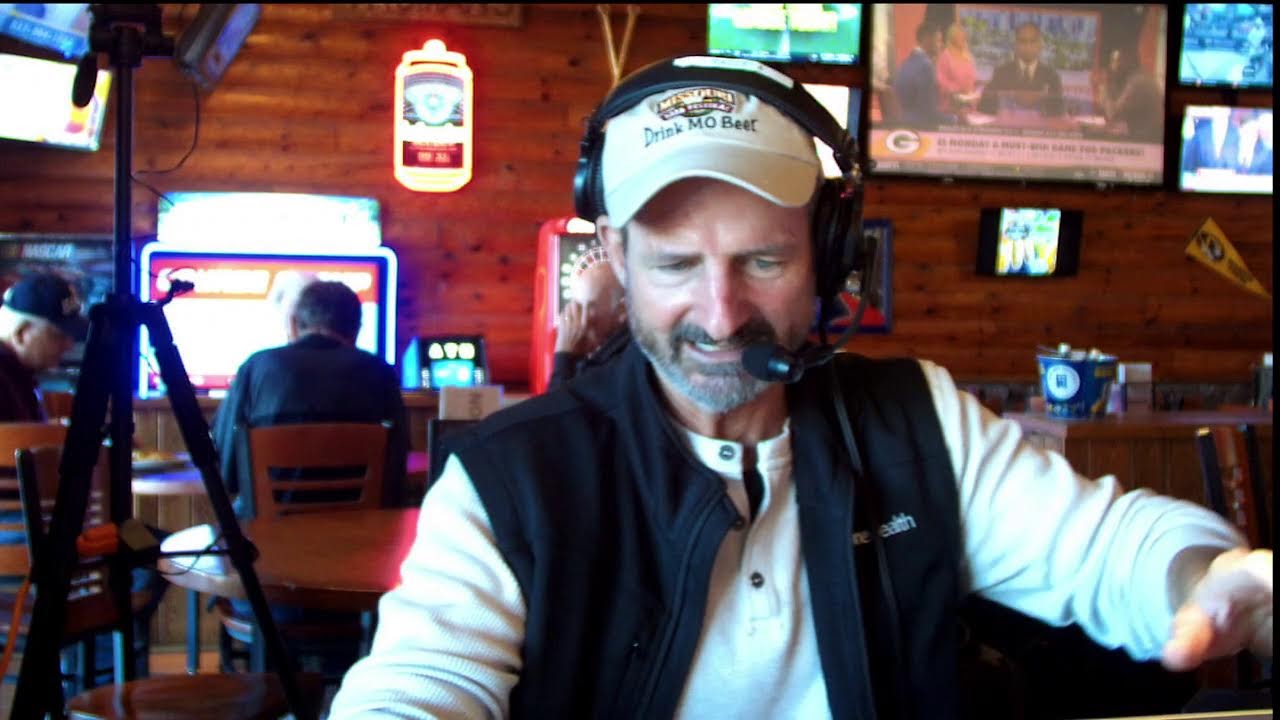
Whether we like it or not, he's the self-proclaimed governor of mid-Missouri, and he's the host of TTBS, the podcast. Since we can't shut him the hell up, here's Tom Bradley. Thank you, Nikki Garman, and thank you to Ames also here at Truman's Bar and Grill where we produce the show live every single Thursday morning unless we decide to take the day off, which we haven't done in a little while, and the holidays are coming up. You did the Moonshoy thing. That was a little different, but other than that, yeah, we've been going strong. But Ames is here taking care of it. She does a hell of a job. Oh, and Truman's Bar and Grill, I saw this this week, a couple of things. Number one, it's happy hour like all the time here, and I saw this post that said $5 double wells all day, every day. You don't drink. No. I don't drink as much as I used to. I don't even know what the L.A. double well is, but it's only $5 all day, every day. So I guess if you like double wells, it's going to be your thing. And if you don't know anything about alcohol, the well is where they pull the handle and it goes in, right? No. Crap. Okay, so what's an actual well? So a well means they're grabbing their, a well drink, the alcohol, the liquor behind the counter that's not like ordered by name. Oh, okay. So that's their well drinks. Oh, okay. Right? Did I get that right? I think I got that right. Because I don'...
Whether we like it or not, he's the self-proclaimed governor of mid-Missouri, and he's the host of TTBS, the podcast. Since we can't shut him the hell up, here's Tom Bradley. Thank you, Nikki Garman, and thank you to Ames also here at Truman's Bar and Grill where we produce the show live every single Thursday morning unless we decide to take the day off, which we haven't done in a little while, and the holidays are coming up. You did the Moonshoy thing. That was a little different, but other than that, yeah, we've been going strong. But Ames is here taking care of it. She does a hell of a job. Oh, and Truman's Bar and Grill, I saw this this week, a couple of things. Number one, it's happy hour like all the time here, and I saw this post that said $5 double wells all day, every day. You don't drink. No. I don't drink as much as I used to. I don't even know what the L.A. double well is, but it's only $5 all day, every day. So I guess if you like double wells, it's going to be your thing. And if you don't know anything about alcohol, the well is where they pull the handle and it goes in, right? No. Crap. Okay, so what's an actual well? So a well means they're grabbing their, a well drink, the alcohol, the liquor behind the counter that's not like ordered by name. Oh, okay. So that's their well drinks. Oh, okay. Right? Did I get that right? I think I got that right. Because I don't know anything. So what's a double well? Maybe you get two shots? I think that's right. Okay. And so that's double wells every day for $5 at Truman's, for what that's worth. As the beaver moon is waning, did you see it this morning on your way in? No, uh-uh. It was beautiful. Beautiful, beautiful. Talking about the beaver moon, it reminds me of like ancient Indian tribes here. Ah, beaver moon. Yeah. Yeah. Was that a guy's name then? There was. It wasn't a guy's name. I'm just, I'm just going to leave it there like that. Today's guest is going to be a former cop. What, do you got the cops in here now? It's going to be a former cop with the Columbia Police Department. And more than just a cop. He was a captain. Nice. And he was a guest on my show. I don't even know. Probably more. He may have. He, what is it? Dalek Baldwin has the most hostings of SNL out of everybody. I didn't know that. I think the person who's been on this show more than anyone else in the history as a guest, Captain Brad Nelson, Columbia Police Department. And he's been back on since he came back to town. Of course, he's retired now. That's good. These guys, they live in the lap of luxury. They're all their lives. And then we give them this huge check every single month and they walk out to their mailbox like, honey, you came in again. The lap of luxury. Yes. That's where they get their shot at dealing with the dregs of society. Oh, yes. The lap of luxury. Why do you got to bring that stuff up? I want to talk to Brad Nelson today. I think we're going to get stuff from a guy that really, really knows it and is no longer employed by a police department. So he doesn't have those golden handcuffs on that are keeping his mouth shut. I don't know about him and golden handcuffs because I don't know what he's got going on at home. But he's also a former chief of police in Salina, Kansas, so we'll talk about that as well. Ellis Bennis, you're catching him over here, floating axe. And there's a lot of changes going on. Just a real quick mention of the housekeeping behind the scenes is that because of Facebook not allowing a live video that's been posted to our page, to anybody's page, to exist for more than 30 days, it has put a quandary in front of us. What do we do with that? So we're live on YouTube right now. If you follow us on our YouTube channel, you can catch it live if you give a damn about that kind of a thing. And if you don't, we will have the recorded version of this podcast unedited. Months after we finish the live send to YouTube, the recorded version will go over to Facebook. And then without video, we'll have that available on the podcast sites like Spotify. But you can put a video on Spotify, is that correct? Yeah. Should we start doing that? Sure. Why not? You haven't even told me to. Oh, I know. It's because I've got too much going on. I don't want to overwhelm you. I mean, just the live this morning on Facebook was tough for you. Dude, I get overwhelmed so, so easily. So there's some crap going on behind the scenes. Sometimes I do as well, because I don't even know what the hell I'm going to say next. I'm ready for the big announcement as well. Let's let's release the hounds. All right, releasing the hounds with a big announcement brought to you by Creekside Pet Center, which would include Creekside Pet Center and Columbia's own Dog and Biscuit, the Bed and Biscuit, the Dog and Biscuit. That is the Creekside's Bed and Biscuit going on at Dirty Harry's in Bloomville, which are all part of MidMoDogBoarding at MidMoDogBoarding.com. It's always funny to me that the first two are very much like dog boarding names, right? And then Dirty Harry's. Right. I laugh every time you go through the three names, because it's like, definitely boarding, definitely boarding. Dirty Harry's. Could be a bar. Could be something else. It could be. It is interesting that we got a former cop on the show, and I think he might have appeared in one of the early episodes of the Dirty Harry's series with Clint Eastwood. Nice. I think I'm old enough to have been there doing those things. This is why we can't get guests, Tom. Just kidding. Big announcement this week. Last week I told you I wasn't going to close out with hookah hay. I had a lot of stuff going on in my life, in my mind. My whole day was messed up. Well, I'll give you a little heads up today. I will close with hookah hay. Thank the Lord. And speaking of the Indians and the beaver moons out there, last week, thank you Big Tree Medical and your help on this, and Advanced Radiology, guess what I did? Did you do the thing? I did the thing. That's awesome. I did the calcium screening. I'm getting mine scheduled today or tomorrow. I'm so excited. Really? Yep. Well, I would encourage today or maybe tomorrow. Don't wait the weekend. Yep. Don't wait the weekend. Because I don't know what you've got going on with you. But you know, I've had some people that have gone through some health stuff recently, including as I mentioned before, Brad Newkirk, which is over at B&B Bagels. And they opened him up, man. And they went into his chest. Open heart surgery? Oh, man. At least they told him ahead of time they were going to do that. I'd like to wake up and go, what the hell just happened to me? And he's one of the most physically fit guys that I know, especially in his early 50s. And me being 10 years older. And because of my mom's history, it's like, I've got to go get that calcium screening. I don't have anything going on. Brad did have a little bit of stuff, some tweaking happening inside him. And he's like, I've got to look into this thing. I went and got the calcium screening. There's nothing going on. But we had done some blood work recently with Big Tree Medical. And my scores came back perfect. Nice. That's awesome. And at 62, it's like, yeah, bitches, what do you want now? Let's do a calcium screening. So we went and did that. I did the calcium screening on Monday. I'm sorry. Yeah, on Monday. All right. I got the results on Tuesday. Wow. And by Wednesday, I got myself a cardiologist. Nice. Who's your cardiologist? And I was on statins as well right then and there. That's awesome. She's a wonderful doctor at Boone Hospital, which is where I thought I'd wear my Boone Hospital vest over here today. No, I have a cardiologist because I flunked my calcium screening. Oh. That's why I was having trouble by Thursday going, I don't know what I'm going to say over here. It's bad. Really? It's really bad. Oh, man. No, I'm not just saying that. Yeah, yeah, yeah. So although I did lay a dollar down yesterday with Brad Newkirk on which one of us had the worst screening, and I'm like, mine, when you get up to the numbers I had, bitch, get out of my way. He goes, I'll bet you mine was worse. We laid a dollar down. He won. Well, did he? It's a good point. It's a good point. So I've got an appointment coming up with a cardiologist. Here's the deal. We had Sarah Hill on the show talking about her heart attack. Whose arteries were perfect, by the way. Oh, my gosh. I know. And mine, the worst one in me is the Widowmaker. It's the descending anterior yada, yada, yada. It's right here. Right there. But I'm doing great. And thank you, Big Tree Medical. And you work with Big Tree Medical. Yep. So big announcement this week is that this stuff happens. It happens to all of us. And it doesn't matter what's going on in your life because I'm healthy. I've taken care of myself for years. You can't keep me away from the gym. And hell, I haven't cut back the amount I was drinking two years ago. That's a big deal. Yeah, big deal. That is a big deal. But it can happen to anybody. And I think Brad Newkirk is a perfect example of that. So big announcement this week. Don't forget to take care of it. You're getting your screening. When is it now? Yep. I'm meeting. So I've got a cardiologist. I'm meeting with him tomorrow. And so we're getting it scheduled from there. And was you right? Was it like $100 for the screening? Was it pretty reasonably priced? I don't know. It was way over. It was $105. That's great. I mean, that's worth every penny. So make sure you get a little bit more on there and take care of that. But, yeah, it was $105 and that's it. I'm ready. To know these things. And if you have any kind of a family history with that, you want to check into it sooner than later. How old are you? I'm 41. Good. I'm glad you're taking care of it now. Yeah. You'll have a really good base to work on this. All right, folks. I want to hit that music bed for our guest this morning and introduce to you a guy who really, throughout all the years on radio, I think he was on my show more than any other because he had this standing appointment. How often did you come into the show? Do you remember? I thought it was weekly. Weekly. Every week? Wow. Every week for Crime Stoppers. Every week for Crime Stoppers he'd come in. That's awesome. Remember when we would do the Crime Stoppers stuff? Yeah, man. And now it's like, bitch, you see him? Arrest him. Yeah. It's just like, don't even. Right? Yeah. Ladies and gentlemen, former captain with the Columbia Police Department and chief of police in Salina, Kansas, and now retired and living the good life. His wife feeds him figs every evening as he lays on the couch, Brad Nelson and a good friend of mine. Good morning, sir. Good morning, sir. Thanks for having me. Thank you for being on here. Do you want to mention as to how this wound up coming about that you would be on this show? Do you know what was going on in my mind? Why I invited you on? Do you have any idea? I would assume all the issues with downtown and with panhandling, but I'm not certain. You lived back in mid-Missouri, by the way, after you moved to Kansas. Talk about a stab in the back moving to Kansas. How long were you chief of police there? Eight and a half years. Eight and a half years. That's a long time to live in a completely flat, boring state. No kidding. No kidding. Eight and a half years. I was going to introduce you with like, in eight and a half years, did you ever have the mafia invade? No. You kept them away. I thought, I can't go into anything too serious because I don't know what the hell happened there. You had murders in Salina? Sure. During your tenure? Right. More during … Probably less. Probably less. I might add, I want to start this conversation with, I don't appreciate my back of the door. That doesn't work for you, does it? It doesn't work at all. Actually, I don't like it. It doesn't work. I'm right there with you. This is one of the few times in an establishment, like a bar, that I've been like, hey, this guy's a cop. One day we were out somewhere and I said, hey man, do people know your police officer? He was like, shut the hell up. You were like, Tom, don't ever do that again to me. Correct. Why? Tell me why. I'm very proud of the occupation, but a lot of people can tell just by looking at cops they were a cop, but there's no need to advertise it because in this climate we're in, some folks don't like us. Do you really think somebody can look at you and know you were a cop? My wife swears they can. Yeah, I think cop or military carry themselves a little bit differently. Probably look a little bit different. Just the way they carry yourself. Yeah. There was a time when cops had mustaches just like, does your son have a mustache right now? He has a full beard. Oh, not a full beard. But he has a beard and a mustache, yes. That's good. Is it a reasonable mustache or does it look like a pornstache? It's not the pornstache. In my day, you couldn't have the beard, and now they're letting them neatly trim beard. I'm not a big fan of that, but it is what it is. Your son is a cop with the Columbia Police Department, so full disclosure on that is that that happens. I'll probably watch some of the things we bring up, or you will, as to what we're saying, but you're proud of him, he's doing a great job. How long has he been on the force now? Nine years. God, I can't believe it's been nine years. He actually just made sergeant about two months ago. Congratulations. Congratulations. That's awesome. Yeah. Has he kicked some ass? I will say, I think he's also on the SWAT team, and I was on the SWAT team for ten years, and we're the first father-son combination in the history of CPD SWAT, which started in 1976, to ever be on the SWAT team. Wow. Were you guys on at the same time? No. Oh, okay, so you were active, then retired, then he was active. I retired in 13, and I think my son was hired in, well, whatever, go back nine years. But it's not too far off. No. I missed him by a couple years. It would have been sweet to work with my son. That's pretty cool stuff. You worked with, now, Chief Schlute. She was in several different roles throughout that time, and I'm guessing you probably were not a captain when she first joined the department. Maybe-ish? Uh, no. Okay. I think she only joined a couple years after me, so no. Okay, all right. And she is now, I believe, eligible for retirement, and she swore to us, didn't she swear? 20 years. This appearance has nothing to do with Captain Schlute being on just a couple of weeks ago on this show, but it has everything to do with what's going on in Columbia. And you sent me an email, and you included a couple of things in there. Some of your views on the world, on what's going on here locally. You included a file on there. I think you sent me some information over the years, the Columbia Police Department. And you were talking about, currently, how we're handling things. And that's where I kind of want to start this and say, okay, you're sitting out here in mid-Missouri watching what's going on in Columbia, and I don't want to put words in your mouth, but you've said you believe Chief Schlute knows what she's doing and we're moving in the right direction. Is that- Absolutely. Oh, yeah. That's a lot. Yeah. She's a breath of fresh air for who I had when I was a captain. Yeah. Well, let's go ahead and say it. Chief Burton was here, and that was not working for you. That was not working for a lot of us. That's correct. When you were on my show last, which was after you retired from policing, did we bring up Burton and your view of him? I'm not sure. That would have been pretty fresh. I'm not sure about that. But when you were on the show as a captain with the CPD, you couldn't go on there and go, by the way, our chief of police is on. Absolutely could not. Piece of work. And nor would I, but you couldn't do that. He posted recently on social media, and it came up in my feed. And I'm not going to tell you what he posted, but I was like, damn, is he still running a police force? Was he still running a police force? I actually saw that. Was that the death of Chief Barbie? I saw that. Facebook. I can't remember what he posted. Well, I saw that, too. I was surprised he posted on that, too, because I don't even know if he knew the man. Yeah. Yeah. It was… Oh, hang on. Chief Barbie was a guy? He was chief for many years here, probably a 25, 30-year CPD cop. Yeah. All right. He was the chief that hired me a long time ago. All right. Very good man. Long time ago. And we had a chief that you did not think highly of. You couldn't say that during your appearances on the show. I knew it. I could say anything that I wanted to. And things just kept getting worse and worse and worse until eventually we told him to get out. But now, you can say anything you want to, and you've told me Chief Schlutie is the right person, right time, and knows what she's doing. I concur. I think we're definitely heading in the right direction. That is… God, that means so much. That's good to hear. And you and I, Ellis, when we had her on the show the first time, a couple months ago, I was surprised that you were also. Yeah. I was like, she's saying the shit that I think I'm supposed to be hearing, that I want to hear. She was way more plain spoken than we expected her to be. Yes. She was still very diplomatic, but she was way more plain spoken than I expected. And I really thought I'd get political answers. I think that's great to point out. And so, we're expecting you to be plain spoken today too, as well, because you don't have anything to cover up. That's true. Although, you do have a son that's working on the police force right now. But generally speaking, I mean, I don't remember when you were on the show years ago, I don't remember talking about gang violence. But did you guys behind the scenes always know it was gang related violence during the years that it has been? Well, there are certainly loosely organized, you know, gang is such a scary word. For a while we weren't using it, but there's certainly gangs, but back in the day it wasn't like blood and crip stuff standing on the corner. It just wasn't. When you say that word, the perception is that's what we had in Columbia, and we never had that to my knowledge. But we do have ties. We certainly have ties. With people here that are between the ages of about 19 down to about 13 or 12 that have ties to main gang activity in Kansas City and St. Louis. I'd say absolutely. And you said we didn't use the word gang back then. It was frowned upon, I'll put it that way. See, this is what I'm talking about. But behind the scenes, you and I would talk about this stuff, and it was gang activity. The one person who didn't have anybody telling him to say or not say whatever was our Boone County Sheriff, Duane Carey. And so he's always said, no, it's gang activity that we have. And now, didn't Chief Schlutie mention that already on this show? Yeah, she talked about it. And so now it's out there. So it's being accepted and used and not frowned upon. The big difference is the Sheriff's answer to their constituents, which is 175, 180,000 people in Boone County, where Chief Schlutie answers basically to one person. So if you upset that one person, being the city manager, you can be in hot water. Did you answer to a city manager in Salina, Kansas? Oh, sure. So my point is, it's a lot easier to be a little more outspoken when you're speaking to 100, whatever, 75,000 people. And a few are going to get mad no matter what you say, of course. But if it's just one subject, which would be your boss, the city manager, you could say one thing and be fired the next day, in theory. A little drastic. And so that city manager may be telling you, we're not going to use the word gang. Absolutely. You definitely get rid of it. And the city manager may have zero experience with a police department working within one. Or they may actually be from Ferguson, Missouri, which brought a lot of experience and possibly other baggage and issues that we don't even understand. Isn't that correct? That is correct. Or the city manager could have access to Google, which makes him an expert. Oh, of course. Absolutely. Was the Ferguson comment true? Yes. Our city manager in Columbia was the city manager of Ferguson. I did not know that. Another way to look at this, too, is that the Boone County Sheriff, yeah, speaks to the thousands, almost 200,000 or whatever we got in Boone County. They're also the ones voting him back in every few years. So maybe it makes sense for him to just go ahead and speak from the heart and knowledge that he's seeing every day of what's out there, speak honestly to people instead of following some sort of guidelines and talking points. Yeah, I definitely respect Chief Carey for doing that, but again, it's totally different than if you're a police chief and you have that one person that could ruin your career. I don't want to say ruin your career, but could end your career. But they could end the career with that sort of a thing. What we have in Columbia right now, I think this is really important for a lot of us to know and to acknowledge. We don't necessarily, possibly necessarily, have more violent crime than we had a month ago, a year ago, or ten years ago. But there is a feeling in Columbia, I believe, among the constituents, which is we're done with this level. And I also don't like where it's happening and who it's happening to. Would you see that and agree with me on that? I would agree. I think all the stats would show, except possibly property crimes. Property crimes are almost always going up or staying the same. But people aren't that much worried about property crimes, they're worried about persons' crimes. Crimes about persons, the murders, rapes, those types of things. When you say property crimes, you mean theft? Yeah, robbery, theft, robberies, shoplifting. But what people get excited about, and what gets really concerning, of course, is anything violent. There's a tipping point where people have just had enough, and even though the stats won't support the fact that crime is out of control, because they don't, and it's not, but the perception is, because of some pretty high-profile incidents, mostly downtown, and yes, that got a lot of people upset, rightfully so, that's what's causing what's occurring now. Back in 2014, in the email you wrote to me, I can share pieces of this? Without recalling what it says, sure. No, no, no, no, no. In here, I was starting to say back in 2014. This is from the email you sent me a month or two ago. It says that there was a mayor's task force on community violence. Is that correct? Yes. In 2014? I think that's when the results came out. It happened 13-14, yes. You said, I think it would be quite relevant to research what recommendations were put in place, and if implemented, what were the results? What a great idea! And this was on the heels of the mayor of Columbia going, we need to put together a task force. And I'm like, well, wait a second, you're the one who was saying, you know, over the last year, many times, you were alluding to that we don't have any violent crime to be concerned about. The brand new thought of having a new task force, sarcasm intended, was what caused me to realize we've already done that. You've been there, done that, and you can't keep doing the same thing and not thinking you're going to get the same reaction, the same results. And I think that's what caused the turnaround. Not because I said it, but I think a lot of people thought you were a convicted felon. Oh, that's right. It's the most amazing thing. The problem we have, everybody, is when you're a convicted felon, you serve time in one of our state institutions, when they let you back out, you can't get a high quality job. Because on every application it says, check here if you're a convicted felon. Well then you can't get a job, which means you're going to sell narcotics illegally on the streets and kill people because of the box. So we took the box away, and so the city put out an order and said, you can't ask anymore. You can't ask. And within a month, I was filling out an application for an event permit with the city of Columbia, and the damn box was on there for me. They wanted to know if I was a convicted felon. What the hell is that? Which, by the way, I'm not. I'm glad you clarified. I was going to ask. I was going to ask anyway. Did you? Yeah. And you know what I did? I beat the crap out of somebody behind the counter who was asking me if I was a convicted felon. That's what I did that day. No, ban the box was actually tied to that mayor's task force. That's one of the first things they actually did, if I recall correctly, was initiate that ban the box thing. And you said, did it do any good for us? I'm like, I don't have any idea if it did. Well, A, I don't know how you measure it, and B, I just think it's silly. You meet for months and months and months, and that's a suggestion? Ban the box? I don't know. We've had a number of city council people in all these years, since around 2014. They come and go. And sometimes it's sort of like shark teeth, man. It's just a conveyor belt, you know? One falls out, the next one jumps right in. It's identical to the one that was just there. Michael Trapp was a city council person in Columbia. He since has left, and he lives in Kansas, although occasionally chimes in. His brother is still here, and I'm not making this personal about family, but that his brother is still here working among trying to help the homeless. However, his brother John and I don't see eye to eye on how the homeless should be helped. So that's just a little bit of tidbits behind the scenes. Michael Trapp has a good heart. It's usually headed in the wrong direction. He is an intelligent person, but he and I never come to the same answers on queries out there. Michael Trapp, of all the people in Columbia, in all of our history over the last couple hundred years, he was the one put in as the co-chairperson of this Mayor's Task Force on Violent Crime? Right. Why? That was quite surprising. What the hell? He must have ten years' experience on a really good police force that I'm not aware of. Is that correct? I'm not aware of it either. You didn't serve with him? I did not. Michael, cover me. I'm going in. You don't remember that one? I don't. Does the Call of Duty count? Does that count? Can that be a thing? Let me tell you something. I've never played that. Me neither. But I don't believe that Michael Trapp has ever played Call of Duty. That's my guess. I hope Michael is catching this podcast right now. Hello, Michael. I hope you're doing well in your life in Kansas. I hope it's so well that you decide to stay there and never come back here. That's how much I care about you. And I… What? That was kind of a face. No, I'm good. I wasn't positive. So that's interesting to look back to 2014 and see those things. You were on the police force during those years. I retired in 2013. Oh. Oh. So it was right around the edge. Yeah. That was just starting. Yeah. I didn't realize you'd been taking it easy so many years. Be that as it… Be that as it may, when you sit on the sidelines now, okay? Talk about armchair quarterbacking. You get to do that all the time. What do you see us doing in Columbia? What's bothering the hell out of you here? Well, I'm probably going to beat a dead horse, but I hope to have some other thoughts on it. But the whole panhandling thing, the whole mediums, the whole welcome to Columbia and this is what you see, it literally is the first thing folks see that comes here from out of state, out of the city, whatever. That's what they see is just this huge mass of folks that are at almost every intersection, it seems like, all asking for money. And I'm all about helping people, but there has to be a better way than standing on a 6'5 medium with your feet dangling out asking for money. And that's a daily, daily occurrence. Do you think that that invites other problems? I know that it's a problem on its own. I know it's dangerous to sell. I know it looks like crap to everybody coming in. It looks like crap to me. But does it invite other problems out in the public? It invites other problems as far as when you're giving these folks cash. 99.9%, they're not going out and buying a nutritional meal. They're just not doing that. They're buying something to feed their addiction. So it's definitely hurting by giving these folks cash, even if what you're trying to do, good intentions. It's just not what's occurring once you hand them over a $5 bill. The establishment we're in, we were just talking about the $5 wells moments ago. They serve alcohol. I drink a beer or two every evening. Alcohol is all over the place out here. That's one of the things some of these people will go and buy with the money that you're giving them. Right. What's the problem with that? Because you're just continuing, you're enabling them to continue their lifestyle, their behavior. I mean, just like giving them $5 is not going to change their life. Giving them $10 is not going to have them buy a house. If we give them a house, it's not going to cure their addiction. There's so much more to that. It's not going to cure their mental illness by giving them money or providing them with low-income housing. It's just not. What are the other things that they'll go buy with that, the other substances? What else? What did you always find out there on the streets? As far as what they're buying? Yeah. Well, when they're not stealing the shopping carts. It's primarily the booze. Apparently, I've seen a lot with actually buying food for their dogs, which that's good. That's a good thing. But I just don't see the effort in trying to get off the streets. That's what I want to see. That's where I think we need to focus our efforts as a city in helping them get off the streets, get off the medium. Are they buying fentanyl? I'm sure. Are they buying meth? They're buying all kinds of drugs. Are they buying opioids? Absolutely. Yeah. Whatever the drug of choice is. I don't even know what else there is. I lose. It's all the same thing to me. What do you know about? I mean, right. Do you roll a crack joint? Crack. Is that crack? Crack joint. I'm showing you my extreme level of knowledge on drugs. You don't even speak the lingo, man. You don't speak the lingo. I want to bring a homeless person from a median just down the street from here. I want to bring him in on this show. You've probably had better ideas. But what I would suggest is you don't know what they're carrying on board. And I mean drugs, alcohol. You don't know what they're carrying in their pockets. I mean, there's a lot of things that go on before I would just set this person I met five minutes ago in front of me and expect something brilliant coming out of their pocket. Yeah, you know, the horrible thing about that. First and foremost is in the humane, the most humane way I can possibly bring this up, themselves. They are a danger to themselves. Yes. Probably more than anyone else on the planet. They're the most dangerous to themselves, and that's it. But I think when we talk about bringing these people in, you were on the streets working with them. How the hell did you walk up to a person who was whacked out on something, living on the streets, half clothed? How did you walk up to them? I mean, that's got to be gross. It was hard, but you had to. I just want to say I'm empathetic to their plight. I'm sympathetic to their plight. I just want them to get help and not to keep on doing what we're doing, which is to hand them $5. We have to do something better. The $16 million, whatever it's called, that's coming forth, I think that's going to help. But, again, we can argue whether or not it's going to draw more in. I don't know. But at least it's a place. Hopefully the police can drop folks off without being tied down with three hours of paperwork and drop them off there and then drive away. And hopefully they'll get assistance they need. I'm going to ask you questions about the medians and other cops. And I only want you to give me this thing from your own perspective, all right? Okay. So no names, and I'm not saying the police officers of the CPOA or the Columbia Police Force or Jeff City or anything else. From what you know, if five, six, eight cops that you know, former and current, were all to join you here at Truman's, and you guys were hanging out for breakfast one morning, would any of them go, I think they're actually, I think this is going too far with this median ordinance. I think we need to allow people to be on the medians. Would any of them say it's okay for a citizen to be on the median and hanging out? None that I've known. Okay. I mean, absolutely zero. So when they hear that we're going to the point of having an ordinance, do they say that's good? Do they laugh out loud that we even have to get to this point? What is going on with your conversations behind the scenes that us guys never get to hear? Well, the big thing is we're the ones who have to enforce whatever law the person makes who knows nothing about enforcing laws. You know, we have to enforce those laws. For instance, the proposed, and I support it. In fact, I emailed all six council persons and the mayor. You did? I did. And the city manager saying I support this. Now, they don't know who I am. They don't care. I mean, it's just one person sending something in, but cutting pace is a fun thing to do. Sure. So I did send it to all of them. But the thing, the current ordinance, it's location specific. We're careful to say it's not about the panhandlers, but there's not many people standing there other than panhandlers. Let's be honest. You read something a few weeks ago about the person who said there's not many Girl Scouts selling cookies on a medium. That was awesome. That was awesome. I mean, I watched your podcast. That was awesome. What I'll say, the issues, which they don't care what I think, but of the three things, the elements of a crime, there's always elements that we're supposed to be all knowing about every element of a crime. But on this new ordinance, it's not a panhandling ordinance. It's not. It's a medium ordinance. Medium. So it's not a panhandler, but who stands on the medium. Okay. So with that said, it involves three things. The speed limit has to be over 35 miles per hour. The medium can't be less than six feet wide. And the third one, I've got to remember, six feet wide, 35 miles. Oh, there has to be 15,000 cars per day passed by that medium. Yeah, yeah, yeah. But isn't it one of those will mean that median is now not to be used? It's just one. Is it one or all three? No, no, no. I think it's one. It is. No, as far as the medium has to have 15,000 cars drive by it. In order for this ordinance to be effective. And be six feet or smaller. Yes. I thought it was one of those things. If it's on 35 miles an hour, you can't be on the median hanging out, having yourself a little cocktail party. I actually looked this up, and I want to make sure I'm right here. The thing I was going to say is. Because I would have never proposed it that way myself. What are we talking about? Now we have to measure every median. Like, oh, this one has 14,500 cars, so we don't have to enforce it here. That's going to be confusing as 80s. Yeah. And I do stand corrected. It is any of the following. Any of the three. So thank you for that. No, no, no. And I'm glad I got brought up, too. Because I think a lot of people are wondering, or they've been misrepresenting what it is. That's right. So any one of those three. Any one of them. So if it's only 10 miles an hour going by there, but it's a three foot median, you cannot stand on it. Okay. And where I was going with that, and I'm very glad that point came out. Where I was going with that, cops are going to know the speed limit. Okay. We are. We're going to probably know what six feet is. Okay. But no cops are going to know if there's 15,000 cars driving by there or 14,500. Right. We're not going to know. No, no, no. But that gives us, as a municipality, a little bit more enforcement opportunities there. But again, sir, you don't enforce it. My point is the cops are the ones who have to know if there's 15,000 cars or 14,500. I just think that's a silly element of that ordinance. So they're coming up on it. They're like, I'm pretty sure there's more than 15,000. Yeah. But it doesn't look like it right now. Now, the six feet thing's a little sketchy, too, because, I mean, are we supposed to get up there and measure them? The point of this conversation I was trying to say was- He's got a gun. He's got pepper spray. He's got handcuffs and a tape measure. There may be something worthwhile there in that there can be someone could say this is a median and it's 87 feet wide. I don't know. I said earlier, if the folks who made the laws had to enforce them, okay, here's what I'm saying. If I'm going to make this law and I'm going to enforce it, I'm going to say you can't be on a median. That's it. It's easy as that. Other than that, which it makes sense, and I'm with you on this, other than that, you believe that we're moving absolutely in the right direction on getting an ordinance up there to get people off the median? Yes. I don't even know how it can be argued. I really don't. Especially the way it's being framed. It's not being framed about the panhandlers. It's being framed about safety for all who wish to stand on the median. Again, this applies. We talked about a couple of other instances. I know Slootie, she might have made the firefighters mad because she said, I don't want guys out there with boots. We talked about the folks that even if they're supposedly raising money for the sick kids, right? You've seen those buckets. Girl Scouts. This is ubiquitous. We are trying to protect everybody. Nobody should be standing in the middle of an intersection where there's cars going. It's also one of those things where we're saying, look, it's everybody, you guys. Nobody can go out there and do stuff like that. This is not the place for anything going on. So, I'm not the one writing it. I'm not the one voting on it. But I am being honest about it. The reality is, you can't panhandle from a median, as we're enforcing this. You cannot sell Girl Scout cookies from the median. You can't take yourself a little nap on the median. You can't shoot up heroin and hang out on the median while you're enjoying your trip or whatever the hell. You can't do any of those things. You can't play rummy. All right. Seven-card rummy on the median. Any of those things. Playing rummy? I have a God-given and a constitutional right. Shut up, you, and get your ass off the median. But it's not any of those things we're supposedly concerned about. It's the standing part. You can't. We're just saying you can't stand there and do anything. You can't loiter. It doesn't say standing, does it? If they're sitting, if they're laying, if they're passed out. Occupy. I think it's occupy. Occupy. I hope so. Now, if a median occupies your mind, as it apparently has been occupying ours for a long, long time, that is allowed. But you can't occupy the space. And it's also within a distance of the intersection. It's not just the median. You also cannot be up at the corner. And you can't approach cars that are sitting at the light or rolling through the light. That's actually interesting you say that, Tom. That's already an existing ordinance that was around, I think in my day, that you can't approach a car. Somebody who's inside a car while panhandling. I didn't know that. It's 16186 if you really want to look it up. Wow. Wow. He's got it memorized. How do you know it's 16186? You're sitting around going, ah, it's 16186. He's got it tattooed on his wrist. Yeah. I like to prepare. And what I can say about that is we've had an ordinance against panhandling forever. But it primarily has to do with aggressive panhandling. We all know what that is. Aggressive panhandling. Aggressive panhandling. But it also covers where you can panhandle at. Like you can't panhandle near an ATM. I don't know if you knew that. Oh, I didn't know that. You can't panhandle near an ATM. The whole, you brought it up, Chief Sloot. You can't panhandle from sunset to sundown. That's in that ordinance, 16186. It's written right there. You mean sunset to sunrise. Thank you. Sorry, sir. Sunset to sunrise. Yes. The ATM one. That's really interesting. Because you could be right up next to somebody. And they're like, excuse me. And you're like, no, no. I'm here. When you get that money out, I'm going to ask you for money. I'm trying to put my pin in here. I don't care. I'm right here. That's against the law. If you're bored, you should read that ordinance. Because it's quite long, of course. Because again, we didn't write it. Somebody else did. He doesn't have to enforce it. You know what I'm going to tell the guy when he comes up behind me next to the ATM? I'm going to go, you want to know my pin? It's 16186, bitch. It's what it is. And he'll look at me like, oh, crap. You know your laws. I'm like, yeah. Because I know Brad Nelson. He's got me all trained up on this stuff. That'll get you two tickets. I don't know that it will. It's interesting. And I know a lot of times we say there ought to be a law. And you're like, actually, there already are laws in place. So some of this is already there. And dangerously hanging out in traffic is probably already against the law anyway. So you're probably already breaking some kind of an ordinance by being on a median. I think with some, you know, creative thoughts, you could do that. But it's just how we lived. You really want to go around looking for that to cause some massive issue because they're hanging their legs out in the roadway. I get it with the measurement of the median or how many cars a day. And that's difficult for a company. We delay this ordinance until the opportunity campus for homeless individuals is open because it's not fair for us to do this to them now. Oh, my God. And you're on the city council? Holy crap. If it's an ordinance, then that means it's only a ticketable offense, right? An ordinance means that it's municipal. Right. So we talk about a statute. We're talking about a state law. Right. But if we're here talking about an ordinance, it means that it's there. You could use that to do, I'm sure, a number of things. Probably ticketable. You could wind up arresting somebody for breaking a city ordinance. You could, but you're not going to be arrested for standing on a median. Now, unless you refuse to leave because that's refusing the lawful order. There's all kinds of other things. Right. But, I mean, I'm just thinking, like, let's say it's a ticket. Well, what happens if, you know, you've got a guy with 100 of these tickets now. Is anything ever going to happen to him or is this just going to be one of those ordinances that, you know? You hear that a lot. But as a police officer, I can say once I write a summons to you for standing on a median, it's not my concern what happens after the fact. Right. If you get one every day, well, you're not learning. At some point, you're going to get arrested because they're going to issue warrants. Now, that is the end of the cycle. I think I understand that. But what choice do we have? I mean, all we can do is enforce the laws as we see fit. And if you choose not to go to court or not to handle it, that's not my issue. It makes more work for a lot of officers because they end up arresting you and it just goes on and on and on. Let's say that this morning or whenever anybody's catching this podcast, we've got current members of the Columbia Police Force catching this. And are they like, oh, yeah, Brad likes the law, but he doesn't have to work here anymore to enforce this crap. Yeah, of course it is. Are there some cops going, please don't start this because I don't want to have to work with it. Or are they saying, good, I'm glad you're putting an ordinance out there. Now the public will understand why we stopped, put on our lights, stepped out of our vehicle, made sure everyone was safe, and got this person away from the media and took them over to the side of the road. And now we're going to talk to them, maybe give them a summons or whatever it might be, a little citation or whatever's going to happen. But get them off of there. Will the cops be happy that we're going to pass this ordinance? That's a superb question, and I'm going to answer it. I've been gone for 13 years, but what I would say is I don't think they're going to do backflips over another issue that we have to deal with on a daily basis. But at least it gives us more in our toolbox to deal with them. But I think the biggest thing with the department now is the whole recruitment and retention. It's a lot easier to be proactive, and I saw Chief Sweeney talked about that. But it's a lot easier to be proactive when you're down 10 cops versus when you're down 50 cops. If you're down 50 cops, you just drive by with blinders on because you're going to a call, for one thing, and you just don't want to mess with this individual again because he's going to be there tomorrow and the next day and the next day and the next day. So I'm a little mixed on that. I probably should ask my son that because I don't want to speak for him. I want to talk about the number of cops. So help remind me, and we're going to talk about Salina and Columbia and your perspective on that. As we finish up the stuff on the ordinance, on the panhandling and the media and all that crap going on, I think we could wind up seeing this get passed. I think we could, and I hope that we will. To the violent crime, I want to ask a question. Somebody brought this up to me. I believe it was not on the podcast. It was way behind the scenes. And they said, you can move some of the violent activity away from downtown Columbia, but you're not going to end it. And I said, I'm with you there. Look, some crap can always go on. And the best you can hope for is to get it away from such a heavily, even if it's just people passing through on a Friday night, populated area. Although there are a lot of people that live in downtown Columbia. I mean, a lot. So more per square block than in your average neighborhood of single-family residential. So there are a lot of people there. You can move it away from that, and that's a good idea, but you're not going to get rid of it. But the real problem that you've got to talk about are the college students that are buying the product that is bringing bad elements into downtown Columbia. And I said, oh, so you're talking about drugs. And they said, yeah, we can talk about protecting college students all day long. And Moon Choi is right to be concerned about safety for his students, because that's his responsibility. But if you allow kids to come down there buying their drugs on the streets, all the bad stuff is going to come in. And I'm like, oh, so I don't know what the next step is. Is that person who talked to me, are they right? Is that a reality? I don't know how many. I don't recall the downtown being a huge area for actually buying the drugs in my day. I don't know if I recall that. But you certainly have a whole huge influx, and they're certainly not buying them from the panhandlers, of course. Most folks don't want to. I don't think I've ever seen open-air drug sales in this city. That's the Detroit, Chicago stuff where they literally stand in the corner, and you just watch them exchange money for plastic bags. You know so much about policing, about the streets. And you know bad guys when they're 80 yards away. You're like, that guy right there. I'm like, really? You're like, yeah. I spent a lot of time with you and a lot of other cops explaining to me what you see that I never see. You don't think you sound naive by telling me there's no open drug sales on our streets? Did I sound naive? Yes. Do you sound naive with other people going, no, Brad, it's happening right now? Well, I'm primarily talking about what you see in the movies where folks are standing there. I hand you a plastic bag. Open-air, I mean, it's like open-air prostitution. Do you think there's open-air prostitution going on? I've looked. I can't find it. That was the wrong answer, Tom. That was the wrong answer. Sorry. We always need to levity on this stuff. No, no, no. I do not. I don't think that I have seen. Wait, wait, wait. Let me back up for a second. Yeah. I believe I have seen females on street corners that are begging for money, and I'll bet you they have earned it the hard way on these streets. Yes. Other than that, other than some of the homeless, really serious addicts who are out there, no, I don't think so. How about the open-air drug deal? Have you seen that? No. Not that I would know it, but I'm an idiot. You know this stuff, and I don't, but you're saying no, we don't see it. We don't see it, and I would say we have a street crimes unit that was formed in 2007, 2008, that if we have open-air crime of that nature, I guarantee you those are called hot spots. I guarantee you that five, six-person unit is going to be on that hot spot, which is open-air drug dealing or open-air prostitution. Now, some of you are going to say, I see it every day. Well, if that's the case, I guess we're not seeing it, and call in. Call in and tell us that, because, you know, squeaky wheel and all that stuff. If you call in every day and say they're selling dope on that corner every day, I guarantee Chief Salutey and the CPD is going to do something about it. They just are. When you were going, and you went through a lot of different training throughout all your years, and so sometimes you'd leave Columbia and go to where? Where would you go get training? You go to a conference somewhere? I went to Quantico, Virginia for 10 weeks of training, command level training. Good Lord. I went to National, Tennessee for another 10 weeks. I guess the first 10 weeks didn't set, but I went for another command. I went because I was given the opportunity. It was awesome. But police officers go to so many training, not just commands, but they go to every training you can imagine. I mean, and we have a lot of in-house training, too, which is cheaper than away, but you can't learn everything from the same guy. How do you know what an open-air drug deal looks like? You watch an old Starsky and Hutch episode? I mean, how do you? If it wasn't there yesterday, and all of a sudden this week it starts being there every day, the same five got dudes or three dudes, then they feel pretty comfortable with what they're doing. That's why they're there. It literally could happen overnight. All of a sudden they decide, we're going to go here. Now, there's all kinds of studies that if you do the hot spot enforcement where you hit everything right there hard, you are displacing them over here. Okay, that's true, but the only thing in that is they get arrested and go to prison, and the court system does their job, and the prisons do their job. That's how you stop some of this violent crime. We've had a couple of different people who have spent time in a prison on this show. How old is the podcast now? Six, seven months? I think we're closing in on seven. This is the 26th episode, minus a couple of days that we missed, so we're now over six months. Yeah. In that time, we've had two different drug-dealing convicts on the show. Former. Yeah, former. Former drug-dealing convicts. You're always convicted. They're always a convict, so they are. Once a convict, always a convict. Former drug-dealing, but two convicts on the show. And Meachie especially, three times in the prison system. If I was to have Meachie back on, hey man, do we have open-air drug-dealing going on the streets? What would he answer? Great question. I don't know. If it's out there, I'm sure I'm not seeing it. But the homeless, and I know we're getting away from the homeless and the medians in prison, but they're using drugs. And they're getting the drugs. And unfortunately, some of them are being brought into prostitution and human trafficking as well. It's happening. And the extortion that goes on, even just between what you would think is just a destitute, homeless person themselves, they're extorting the one next to them as well. So there's a lot of crime going on. But if they're taking meth daily out there with the money we're giving them from our cars, they're getting the meth from somewhere. Where? Well, there's a lot of houses that sell dope. I mean, there's all kinds of places. So is that where we're getting our illicit drugs? Well, sure. But you can also meet in parking lots. I mean, parking lots are, I get in your car and I get out of your car in one minute. You know, what happened in one minute? I retired from CPD in 13. But what I can say, I still obviously have some contacts. But I can also say two weeks ago, I rode with my son for seven hours, six or seven hours, downtown and then mostly north of I-70. But just because I wanted to and he was happy to have me there. It's hard being the dad when your son's a cop. It's probably hard being the son when your dad was a cop. Maybe. Save that for him. But it's also hard not getting out when your son gets out because you want to get out. But the point I'm saying is, we drove around all that time and I certainly never saw any open-air drug dealing and I certainly never saw any open-air prostitution. That's good. That doesn't mean it's not there. I'm just saying I certainly didn't see it. Back to the point though, if there is anything being dealt downtown on a Friday and Saturday night, when we've got, help me out Ellis, how many kids, I call them kids because I'm ancient, how many kids will be down there on a Saturday night? You're asking me like I ever go downtown anymore. I'm just trying to estimate. I think I saw 500 spilling out from the patio area to the sidewalk waiting to get in line to those who didn't care about getting in, in front of Willie's three weeks ago. Just look at the high-rises. I mean the high-rises, we've got so many of those that popped up. I mean hundreds. There's hundreds or thousands of extra people down there now. So at some point or another we've got about 5,000 kids are wandering around downtown Friday, Saturday nights, right? 5,000 of them. If there is any drug dealing going on within there, even if we don't call it open-air, if we were to be a little more, if we put more cops out there like we have in the last month and a half, would we see less of the gang and drug-connected activity being brought into downtown Columbia? I would say yeah. And I'm certainly not being naive as far as drugs being sold downtown. There's drugs being sold downtown, but this all started with the open-air commerce. I think the issue with downtown, why it got to this point, is because over the years we've been kind of neglecting the number of officers we have down there, but that's also because of staffing. But we had a chief that we won't name, but feel free to, that three ago… Ken Burton. That might be it. Some people referred to him as Kaboom, go on. During the tenure we got rid of our mountain unit, which is horses. We got rid of our motor unit, which is motorcycles. We got rid of our downtown unit, okay? That's three of the biggest things we should have downtown on any given weekend. Why the hell would we get rid of those three things? Well, he said staffing, but what I'm saying right now, and Chief Slootie alluded to this, I believe we have one traffic officer. Okay, we're 67, 68 square miles, and we have one traffic officer. That is ludicrous. I mean, it's just crazy. We had a downtown unit, I know because I was a sergeant for a while down there, and we had six or seven officers that did nothing but what 27 are doing now. But still, but we were there every night, so it makes a big difference. That all went away. The horses, the mountain unit, that was mainly for special events, but those would have been out on game days for sure. How long ago was that? I've lived in Columbia my whole life. I'm 41. I don't remember ever seeing a cop on a horse in Columbia. You never saw it. We had, I think, three, somebody's going to correct me, but I think at one point we had three mounted… When did it end? Well, somebody came in 2009, so somewhere between 2009 and… That recent? 2015-ish, yeah. Well, I remember when the motorcycles came to an end, but I don't remember the… I do remember the horses, but I don't remember when… You saw a cop on a horse? You remember the cops on horses? I don't remember that. His name was John Wayne. But I'm glad you brought it up, because I want to ask you something else. You and I were in Memphis together, along with a couple of other guys who rode motorcycles down there. We had a great weekend. Fantastic weekend. And I love hanging out on Beale. I love the blues. I just love everything about it. And I also love… People are going to be like, what the hell? I love how black downtown Memphis is, and how the rich history of people that came out of slavery and brought us amazing things, including the barbecue and the blues of that area. I love the sound of someone's dialect from Memphis. I love everything about it. You know what I loved about Memphis when we were there? The horses at the end of the night. Tell people. The horses… I don't remember motorists there or not, but I remember the street cleaners. They followed up. It was the horses first, and a whole lot of cops. And when it was closing time, it was closing time. They go… Yeah! And they ride the horses, six abreast, all the way down the street. And everyone's like, it's time to go. Whoa. Oh, yeah. That's cool. If you don't get that clue, you probably should go home. Because that's what people did. And people just… I don't want to say scattered. They just knew it's time to go home. That's good. And the cops weren't… They weren't aggressive. They were definitely not stopping. So if you didn't choose not to stop, or not to go, bad things are going to happen. There's going to be a problem. And you are on a street. And so this is what is going to happen. And I think it helps reinforce the idea of law enforcement. It's like, I'm a police officer. There are laws. You will not be breaking the law today in front of me. Right. And I think if you look at somebody and say that, and they go, I think he's serious. Like, yeah. We are. And this whole kinder, gentler policing is like, I don't know what you're talking about. When someone's coming at you with a weapon, and we need to take care of them immediately. I was going to say take them down. I'm not a cop. I can say anything I damn well want to. You want to kick them in the shins, and knee them in the nuts, and put your… What's the best place to hit somebody? You were a cop. What's the best place to hit them? A throat? Throat punch. You're going to say that. Elbow to throat. I was pretty good on leg sweeps. Leg sweeps. See? See? And when he cannot fight, if he cannot stand. Yeah. Yeah. I never carried a taser, so I'm really dating myself. Oh, wow. By the time I… Just like they were bringing them out, you looked at them like, I don't need no stinking tasers. Did they not exist when you were on enforcement? Of course they existed. Oh, okay. But by the time tasers came, I never wore a body cam either. The reason is because I was already a captain, a commander. Oh, okay. And these things are expensive. Yeah. So, you know, they need to fill me in my office. You know, they didn't need to do that. So they didn't buy me a body cam. And I didn't really need a taser. Who was I going to taser? Wait, wait, wait. You rode the lightning. Yeah. Well, that was a poor decision on my part. That was during training. So you were trained on tasers. You didn't carry one. But you went ahead and took the prong. You got shocked? Myself and another gentleman who actually is now the… He'll kill me if I say… No, he won't. Chief Young, police chief. I was a captain. He was a lieutenant. And we were watching this 30-minute, just video to video of people being tased. And we all laughed and laughed and laughed. Right? So then at the end of it, he says, well, does anybody want to volunteer to get tased? And against my better judgment, Scott Young said something like, well, if you do it, I'll do it. Are you serious? So we did it. Do you see why I like hanging around cops? Yeah. Yeah. It was a poor decision. It hurt. By the way, I don't want to say this right now. I've been around cops so many times. You guys actually have a pretty good relationship. I'm a cop. I'm a cop. I'm a cop. I'm a cop. I'm a cop. I'm a cop. I'm a cop. I'm a cop. I'm a cop. I'm a cop. I'm a cop. I'm a cop. I'm a cop. I'm a cop. I'm a cop. Well, I'm going to tell you this right now. I've been around cops so many times. You guys act like little schoolgirls when it comes to different things. Like, I paid last time. You didn't? I swear to God, I didn't. And I started going, it was three PBR's, you idiot assholes. We're public servants. We don't have your income, sir. We barely get paid enough to pay attention. Did I tell you that he's, his favorite friend at home is his mailbox where the checks arrive every day? How often do you get paid? Is it once a week? Is it daily? He's like an Uber driver and drops into the house. Yes. No, I, it's, these are, these are true things. I was like, like the leg sweep you're talking about, I mean, did, did you, you did that to people? What? Yeah. Why would you do that? Because you were in a bad mood that day? No, because they were resisting in some manner and we're supposed to use the least force necessary to effect the arrest. That's cop speak. But, uh, and that was just my go-to. Everybody has a go-to. Some people's go-to is mace. Very few people at that time, now that, you know, the straight sticks, there's PR 24. People didn't use those because of the perception of, you know, this club. You're beating people like they were in the civil rights movement in the 1960s. There were very few people that used PR 24. In fact, I don't. Was that the nightstick? PR 24? Well, it was a handle. Yeah, it was a handle. 24 inches long. It has a handle. Yeah. Uh, but people just use, often just use what's best, what they feel they're best at. And I was most comfortable myself between these, either mace or a leg sweep. A leg sweep. You'll sit there to me and you'll, you'll go here. Let me show you with your pinky. And I'm like, I am never giving you one of my digits. It's not going to happen because you can hurt somebody. Right. Don't you know them all? I don't know if I know them all, but there's certain, like I said, there's certain things that when you're training, you really see, ah, that works. I can do that. Cause it's not everything. Some of the stuff, like the whole, I don't want to bore you with the PR 24. There are all these things you could stick it under your arm and, you know, count to seven and close your right eye and it would make you supposedly fall to the ground. Right. But when you're training, the people were standing still. Yeah. And when you're fighting somebody, they're not standing still. Also when you're training and the person is standing still, they're also sober and not jacked up on some kind of performance induced thing. There's also agreement between you and I, if you're a cop, don't hurt me, I won't hurt you. We go kind of solid. And that agreement goes out the window when you're trying to arrest somebody. When you are trying to arrest somebody and everything goes out the window, what is it then? Is it like just, is it muscle memory from what you've practiced? It's just, they're swinging at me. It's trying to win and trying to get him into control. Yeah. I say him. At all times. Yeah. It's hard. One more question on this and then I want to talk about numbers on the force. Did you or did you not several years ago say to me, just throat punch the guy and I'm like, wow, what a great idea. Did you or did you not? Because I don't remember. Did you? It sounds like something I would say. I don't know for sure. We're going to leave it right there. I think we've said enough. Before we move on, I want, I want to say what sadness breaks my heart about CPD is right now they're having to decide because of staffing. The fact they have to decide between a traffic unit or a downtown unit, that just, that's just terrible. Cause you, you need both and having to decide, Chief Salute is the ultimate decision, having to decide which one first, that, that's tough. I don't, I don't want you to address the overall numbers and what our goals are at CPD cause you're not there anymore. Even if you do think that you know them, I don't want to ask you those, but I will say this. It's my feeling that that's not a really hard to achieve number cause we keep growing and I feel like our goal that was set years and years ago, I don't know if it's been expanding like as quickly as our cost of living has been expanding and the population in this area just keeps going up. So I'm not sure we're going to get there back to Celina. When you were there, how many cops did you have on the force? Was it 70 or 80? 84. 84. That's a population of? 50,000. 40,000. I looked up this morning and I don't know if I, I don't think I have it in front of me. I think there are over a hundred now. A hundred what? Well, who? I shouldn't say officers at Celina, in Celina. No. I don't. So it's, it's administrative. 72 today. They're, I'm still. Oh, is that what it is? Yeah. Okay. 72. They're low. So wait, they have less officers now than they did when you left in 2013? Okay. For eight years, I only hit 84 one time and that was during COVID. It's a constant battle trying to recruit and trying to retain. Those are equally important. Retention and recruitment. And they're, it's, it's draining. Has it always been that way? Like back, back before when you were entering the academy and you got on the police force, was it always that constant battle? Absolutely not. Every, I think the pivot point was probably Ferguson. Somewhere along there, when all this stuff happened, people don't want to be cops anymore. I say it's the same thing as in the sixties, Vietnam, army folks coming back, getting spit on. It's not necessary. Now, thank God has came back where we respect the men and women that we should. But I'm just saying at one point we were almost to that level despised by, I don't think it was more than half, but we were despised by a whole lot of people. And those folks were the ones that were doing most of the talk and most of the social work. I mean, if you and I get into it, you're a big guy. I may win, but what I have to do to win is going to be ugly. And if you only film the small part where I do something- Throat punch. By the way. That's not taught, by the way. That makes you, you know, let me cuff you. That's all they're going to show. And it looks like I'm some whatever, and it's just not true. That went on for years and years and years in that earnest. I can say I applied at CPD in 1992, and we tested. There's so many people. Everybody says different numbers, but 250 to 300, it was big enough where we went to the Herndon Center and we went to one of their big, big rooms just for the test. And I drove from Kansas City area to test to get a job. And 250-ish people showed up, if not 300. And you know how many openings CPD had? Zero. They were making an eligibility roster. Oh my God. That's how the pharmacy used to be flushed, and Columbia absolutely used to be flushed. You would get 300 people apply for zero positions, but based on your rank, you'd be on an eligibility roster. And then as openings came open, people retired, people quit, whatever, then they would draw you from the eligibility roster. We were talking about the retention, too. I was just curious, my perception was always Columbia can't keep officers because they didn't have the support of the city, they didn't have the support of this. But is the retention more that they're literally leaving law enforcement, or are they just going other places? Both. Okay. Both. I think if I just probably speculation with some years, but I would say a lot of them, you get in, by about year five, four or five, you realize this is not for me, and you go you know, we've had a ton of people go to different places here in Columbia. So if they stay in law enforcement, they could leave CPD and go to the Boone County Sheriff's Office, or they could go to Jeff City, PD? Sure. Okay. I'd say generally we don't have that many. We have had some that went to Boone County. When I was there, it was mostly federal jobs. They were going to the alphabet soup government agencies. It is disheartening, and I know that that's happening. During the defund the police movement, people that were leaders in their cities were saying defund the police. So we talk about something really reaching above the critical masses, like what? And then some people that haven't really looked into it are like, oh, maybe that's something we should do is defund the police, because that money could be put into something better used, like to help starving children. You're like, wait, wait, wait a second. This isn't the same thing. What's going on? So once it reached that point, and it was happening across the nation, detrimental to cops. No question about that. Do you think it's in cycles and will come back around? We're coming back. But it takes, you know, once you get down so many numbers, it takes years and years just to get back to where you once were, and that's if nobody retires, quits, gets fired in that meantime. I mean, that was my biggest stress-er as a police chief was retention and recruitment. It was pretty rough. It got to the point real quick, got to the point where my command center wouldn't tell me on a Friday that somebody had submitted their resignation because they knew it ruined my weekend. Oh, wow. That was kind of them. That's 100% factual. They'd tell me on Monday. Very, very kind. Is there anything, because I know we've got to start wrapping up, is there anything you think that I haven't brought up that you were hoping that maybe we'd chat about this morning? I don't know. No, I think, I definitely, no, I still think that we're all of CPD. I wish nothing but the best. I definitely appreciate you guys' support for CPD, and we're not perfect. I mean, we do things wrong. There's no question. You're not on a horse anymore. That's true. I'm a has-been. Back to it, by the way, you rode with your son. I know. I wanted to ask about that. You did a ride-along, and you said the tough thing was for me not to leave the car when he had to. He got out to take care of something, and you had to sit there on your hands. I did, but what I think is pretty cool, though, he allowed me to touch his laptop. Well, I can push a button, and now I get his feed, so I see what he's doing, what they're saying. Pretty impressive. Oh, you mean from his… From the car. As I sit in the car… You can see his camera, his body cam. I can push a button on his laptop, and now it's his view from his chest where his body cam is. That's cool. Wow. I still wasn't there, but I mean, it was something. That's pretty good. And then, as we're finishing up, if it's not going to happen today, then maybe the next time that you're on, can you hurt Ellis? Wait a minute. I did not sign up for this. Do you want those little pinky things where you go, here, give me your thumb. I know where you went. You were like, throw a punch. Throw a punch. There is one thing, I just thought of it. I would ask, please, please vote in support of this ordinance on the mediums. And number two, it's so easy to email all the council folks, city manager, it's all on the city of Columbia. All the emails are there. Right at one time, cut and paste, send off seven emails, or eight if you want to send it to the city manager, and just let them know, because a lot of folks like us can't make it to these meetings, and it seems like the same eight people are there at every meeting, and they're all, they usually all get something that, to me, is pretty rare. Yeah, yeah. A throw a punch, by the way, next time. Brad Nelson, once a cop, always a cop. He said we. Did you hear him say we? Yeah, every time. Thank you for being here this morning. It was really, really incredible having you on. And here's the thing that's different about what we do now from what we did back in the day on radio. And we were able to, everyone was like, you can drop the F-bomb. It's like, I don't, have I even said that on this podcast? I think so. Not much. It was impassioned. It was passionate. I was like, Brad. And. You're definitely not Howard Stern or anything. No, no. I'm not getting it. But we get to really just get into it and talk. And I think Heather, who was on last week with us, Heather Overstreet, she said, and I think she meant this in the most positive of way, it's like this ADHD thing that Tom has going. And it's not really, but I can just bounce off something like, wait a second, yada yada, and bring up something else. And so we were able to do that today with Brad, and I appreciate that. It's cool stuff. I swear. He told me you could do the throat punch. Have you ever seen somebody get throat punched? Oh, thank God. We hang out in different areas. You know, there's not a lot of throat punching at the church. One of the reasons why I think it was him, and I'm not certain, is because whoever told me they said, you throat punch somebody, you can take control of the entire situation, but you need to know what you're doing. And if you don't do it right, you could kill them. I swear that's why I think it was him. If your enemy cannot breathe, they cannot fight. Yeah, something along those. You know what we need to do? We need to keep our eye on the crab. Are you ready? You gotta keep your eyes on the crab. You can't handle the crab. Looky here, there's a big difference between shit and shinola. As my great-grandfather always said, Matumba, keep your eye on the crab. All right. I've been waiting to get into this. I had to work this out with several different ideas of what we were going to keep our eye on this morning. It's brought to you by Family Focus Eye Care, which, by the way, I've got to tell you something about these guys. Their team recently attended the Missouri Optometric Association Fall Conference. Oh, God. I can't think of a more boring thing to do for this. During that time, the staff attended to continue their growing knowledge and skill, skill sense on the whole thing. What? But they do that. That's why they're the pros. You're not supposed to know everything about the eyes. They are. It's always changing. That's why they go to a conference like this. They were congratulating one of their team members, Cindy, for earning the Para Award for the longest in the profession, and also Aubrey for earning that award for the newest in the profession. These are cool things that went along with it. Thank you. FamilyFocusEyeCare at FamFocusEye.com. That brings us to keeping your eye on the crap. Airbnb, Vrbo, short-term rentals. City of Columbia put a rule on this thing that said you can only own one. You can't own more than one. Just one. Now, that was some time ago. And we've talked about it, and I've argued the fact, and whatever, whatever. Did you know that I don't think that they're getting the money they're supposed to be getting from the short-term rentals? Because when they made this thing, they also said, you have to pay taxes on these things. You've got to charge. It's a lodging tax, the same damn things we have at hotels and motels all across Columbia. You've got to have that in the short-term rentals. They don't think they're getting enough people to sign up and doing this, so now they've hired an outside firm to come in and get the money. Mm-hmm. I read about this. They spend over $300,000 a year on this firm. Why is it that I don't think the city council members have ever clearly thought all the way through? Did you see the very important line in there that said they don't want to get the multiple competing bids because they want to rush through this as fast as possible? Yeah. Did you catch that? I did see that. They've already decided what the firm will be. They won't put it out there to the general public to say, hey, we're going to be doing this thing. So that's what they did. That screams corruption to me. Unbelievable. They're estimating the number of short-term rentals, like Airbnb and Verbose that we have here. And they said, we've only got about a quarter of them in compliance. So to get them in compliance, we're going to hire an outside firm. I want to tell you something else about the city and what they do. When we propose the idea of outsourcing for anything, they say, no way. We can't do that. Because their number one goal is to what? To protect the Bureau at all costs. To protect the Bureau. And the Bureau is the city government, which they believe is every single employee as well. It doesn't matter what they do for the city. And they don't want to lose a job. The city manager is paid according to how many people work for the city. The city manager… Is that surprising to you? Yeah, it is. I didn't know that was the metric. So the more people they hire, the more money they lose us, the more he gets paid? Absolutely. You've got to remember this. If you're running a Fortune 500 company, it's like, well, how big is the company? What are you worth on the open market today? What are you guys trading for? And how many employees do you have? What's your overall gross sales? We don't have gross sales involved with the city. So they're only measured by certain metrics. The number of employees is one of those things. And if you worked in Ferguson, and you had this many employees, you're paid this much money. And if you go to a city the size of Columbia, and you're overseeing this many employees, it's one of the metrics, absolutely. And all of a sudden, in this area, they want to outsource and go get an outside firm. They don't want to open it up for bids to come in. They just, we're going to go and do this. And they said yes, and it's done. It's already a done deal. Already done. Tell me you're getting a kickback with that. Tell me you're getting a kickback. I think the money that they're going to get from the lodging of these Airbnbs, I think they're estimating it's something like $800,000 a year. We're going to spend $300,000 and something thousand to try and get that. Okay, you guys, as long as it's money that is new coming in, I guess you figure you could spend whatever you want to on that. And you want to know why we're having trouble with the budget at the city level, where I think it's the second year in a row we're not making ends meet? And we should be? This is why. This is why. If you don't keep your eye on the crap, you're never going to see this stuff coming around. So please, please keep your eye on the crap. And remember, that's a five-year contract. I forgot. It's a five-year contract. Five years. Five years of $300,000 and something thousand for your furnace? Good work if you don't get it. Good work all the way through. We've got to get out of here. Now that I'm feeling better this week, I will leave with the catch. So I'll give it to you. My friends, live this day as if it were your last. I say to you, hookah hay, it is a good day to die. It's a good day to die.